Metal fittings in baby and children's products are not merely ordinary accessories—they come into direct contact with infants' and young children's skin and bodies. Safety and compliance are the absolute baseline. One incident and you're not just dealing with returns—you're looking at a full-blown brand trust crisis. This article draws on Shenzhen Songji Button Factory's 27 years of serving international brands to walk you through what CPSC compliance actually requires and how to verify whether a supplier can deliver it. If you are a brand manufacturer of pushchairs, car seats or baby and children's clothing sourcing metal hardware that meets CPSC standards for your next generation of products—this article is for you.
I. Why Compliance for Hardware in Baby and Children's Products is a Matter of Life and Death
The logic behind selecting buttons for ordinary clothing is simple—they just need to be sturdy, easy to open, and rust-resistant. Baby and children's products are a different story entirely.
Infants and toddlers aged 0 to 3 put everything they can fit into their mouths. If a metal button breaks or detaches under force, the loose parts become a choking hazard. The CPSC's regulations are unambiguous: any product intended for children under 4 where small parts can come off is barred from sale.
Then there's heavy metal leaching. Babies have thin, absorbent skin. Lead, cadmium or nickel in the button coating, worn against the skin over time, can enter the child's body. In short, the compliance bar for infant hardware sits well above what adult clothing demands.
Picking a supplier, at its core, comes down to finding one who can stop these risks before they happen.
II. What Do the CPSC and CPSIA Actually Require?
Products heading to the US market face two requirements: CPSIA legislation and mandatory CPSC testing.
The CPSIA mandates that all children's products be tested by a CPSC-accredited third-party lab. For metal buttons as surface-coated parts, the lead limits are strict: total lead content capped at 100 ppm, coating lead at 90 ppm. These aren't guidelines—they're the line between getting into the market and being locked out.
The EU is equally demanding. EN 71-3 tests element migration on accessible parts of toys and infant products, setting caps on 19 restricted substances including lead, cadmium and mercury. If you're selling in both the US and Europe, both sets of standards apply.
China's GB 31701—Technical Specifications for the Safety of Textile Products for Infants and Children—controls heavy metals from the material stage. These standards largely align with mainstream US and EU requirements, so suppliers who clear multi-market certifications tend to have genuinely robust quality systems.
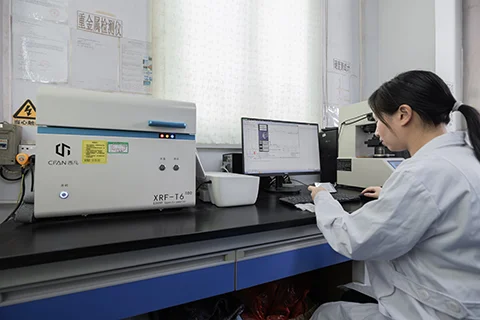
III. Certification is not a Piece of Paper—It is a Full System
Most buyers lead by asking for certificates. For infant hardware, a certificate gets you in the door. What matters is the quality system behind it.
OEKO-TEX Standard 100 Class I is the key credential for infant hardware. Unlike a one-off test, it covers the entire supply chain from raw material to finished product, with traceable test records for every batch. Class I means the material is safe for direct contact with infant skin—one of the strongest safety credentials available.
ISO 9001 tells you a supplier has systematic quality controls: incoming material checks, first-article verification during production, full inspection before shipment, with records at every step. For infant hardware, suppliers who keep test records for at least five years are the ones taking quality seriously.
At Songji, we have cleared 72 international brand audits over the past eleven years (since 2015)—including GAP, Walmart and Carter's, brands with zero tolerance for supplier quality gaps. These audits test record integrity, traceability systems and actual shop-floor controls. Factories that pass them consistently don't find CPSC compliance challenging—they find it routine.

IV. Choosing the Right Material for Infant Hardware
Two materials dominate infant hardware. Which one fits depends on your product.
Food-grade 304 stainless steel handles outdoor products best. No nickel or other sensitisers, excellent corrosion resistance against sweat, moisture and sun, with tensile strength that easily surpasses industry norms. Safety straps on pushchairs, adjustment buckles on car seats—this is where 304 shines.
High-purity lead-free brass is the better choice for garments worn close to the skin. Softer and more malleable than stainless steel, it takes a fully rounded edge without burrs to protect a baby's delicate skin, and heavy metal content sits well below standard limits. Crawling suits, rompers, sleep sacks—anywhere the button touches skin directly.
Songji works with both materials without restriction. We're not locked into one category.
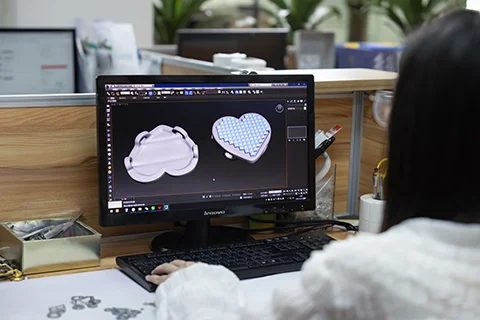
V. Dimensions and Structural Parameters That Determine Safety
Material compliance is step one. Step two is whether the structural design holds up in real use.
Minimum diameter for infant buttons is 15 mm—below that, a detached button fits entirely in a child's mouth. That's the hard line.
Shank design matters equally. For load-bearing areas, shank length runs 7–8 mm with a base diameter of 12–15 mm, spreading pulling force across a wider contact area so the shank doesn't pull through the fabric. For auxiliary fastening, a shorter 5–6 mm shank provides grip without adding bulk.
Shank thickness should land at 0.8–1.0 mm, with a 45–60 degree angle and a bite depth of at least 1.5 mm. These numbers determine whether the button stays secure after weeks of crawling, rolling and parents dressing and undressing the child. The durability demands on infant buttons are far higher than on adult clothing.
Installation has standards too. Professional factories set button-press force at 120–150 Newtons, plating thickness at a minimum of 5 micrometres, using cyanide-free electroplating plus passivation. All edges are rounded and passivated—no burrs, no skin contact risks.
VI. Real Brand Cases—This Is What Real Capability Looks Like
Talking about compliance and specs is easy. Proof is in the brands actually served.
Songji has long supplied custom buttons to NUNA, the Dutch premium baby brand whose line covers pushchairs, car seats and cots. NUNA's supplier standards are notoriously high—they audit every dimension of material, finish, colour and logo, and hold the factory accountable across all of them.
Songji has also supplied custom metal buttons and badges bearing the BMW logo—a category that demands the same precision, material control and traceability standards regardless of whether the end product is a pushchair or a branded merchandise piece.
Songji also works with Joie, Combi and Carter's across varied infant categories. That breadth tells you the factory's material knowledge, process depth and quality controls have been stress-tested across multiple product types—not a one-trick supplier.

VII. How the Factory Verifies Genuine Compliance
A certificate on the wall does not equal a compliant product. The factory's own verification process is where genuine suppliers separate themselves.
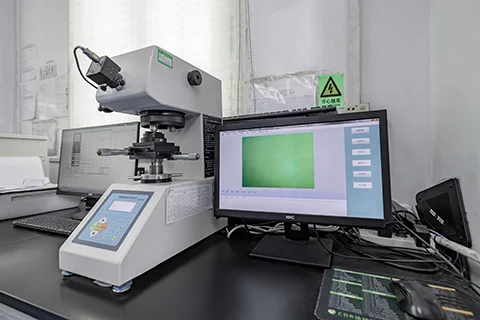
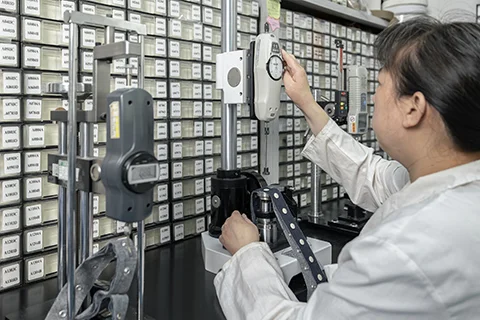
Physical testing gives you the most direct signal. Tensile strength testing shows how the button holds under sustained pull. Fastening life testing reveals how it performs after repeated open-close cycles. Add torsion and impact resistance—these four tests cover the stress scenarios that actually occur in use. Falling short on any one of them is a real quality problem.
Appearance and dimensional inspection are just as non-negotiable. Burrs, sharp edges and deformation are cosmetic issues on adult clothing. On infant products, a sharp edge causes real skin damage. Dimensional drift leads to poor fastening, fabric puckering and loose buttons after installation. Professional factories check every unit for properly rounded edges, measuring surface diameter, total height, shank length and male-female clearance with callipers and height gauges—everything on record.
Functional testing is the last gate. Once the button is set in the finished product, you check flatness, fastening feel, fabric interference and whether the pushchair's fold mechanism still works smoothly. Smaller suppliers regularly skip this step. It's exactly the step that determines whether the product reaches the consumer without problems.
VIII. Three Things That Actually Matter When Choosing an Infant Hardware Supplier
Here is the distilled framework for brand owners making this decision.
First: certifications must match your target markets. US market means CPSIA and CPSC test reports. EU means EN 71-3 and OEKO-TEX Class I. China means GB 31701. Selling to multiple markets? Your supplier needs multiple certifications—not just one.
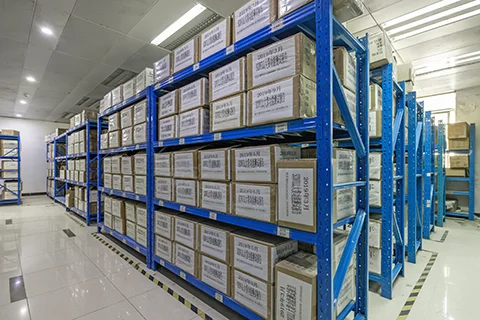
Second: check whether test records are truly traceable. Compliance audits aren't just a one-time inspection event. Brands can pull historical batch data at any point. Suppliers with at least five years of test records have built a real traceability system.
Third: look for cases that actually match your category. Serving a pushchair brand and serving a clothing brand require different capabilities. If your product spans categories, a supplier who has worked across them is worth significantly more.
Songji was established in 1999, operating from a 12,000-square-metre facility in Shenzhen with 27 years serving international brands. Our certifications cover OEKO-TEX Standard 100 Class I and ISO 9001:2015. Over the past eleven years, we have cleared 72 international brand audits with a client base of more than 100 international brands including NUNA, BMW, JOIE, Combi, Carter's, GAP, Walmart and LEE. Our production floor runs nearly 700 machines—fully automatic high-speed punching presses, CNC machining centres, mirror-finish EDM machines, automatic button-sorting equipment, automatic packaging lines and automatic seaming machines—delivering an annual output in the hundreds of millions with consistent quality across every batch.

If you need custom hardware for infant or children's products, reach out. Share your product category, intended use and target markets, and we will walk you through material options and the compliance path that fits your situation.