You receive a button sample, test it by hand, and it feels fine. The bulk order arrives. Workers start fitting them on the production line, and the problem appears immediately—some go on loose, some are so tight they deform the fabric. Within the same batch, the feel is completely inconsistent. The buttons are not broken. The tolerance was never under control.
Precision gaps do not show up to the naked eye. They show up on the assembly line. If you are sourcing for a brand and want to understand why 0.05 mm is the dividing line between reliable and unreliable metal buttons, this article uses Songji as a reference.
I. Just how fine is 0.05 mm
A human hair is roughly 0.07 mm across. At 0.05 mm, the dimension is finer than a hair—completely invisible to the naked eye. Yet on a button, this distance determines whether the fastener works.
A garment typically carries multiple button positions. If the tolerance varies from piece to piece—some slightly oversized, others slightly undersized—the assembly feel will be inconsistent. Workers on the line end up adjusting pressure from one button to the next, and the production pace drops. More seriously, an oversized button deforms when pressed; an undersized one releases too easily. Neither is a material failure. Both are tolerance failures that began at the manufacturing stage.
Songji operates two tolerance bands. General dimensional tolerance is held to ±0.05 mm, and functional dimensions—the areas that directly affect assembly precision and load-bearing structure—are held to ±0.025 mm. These standards were not decided arbitrarily. They were built up over 27 years of working with different product categories and brand requirements.

II. Where tolerance actually matters
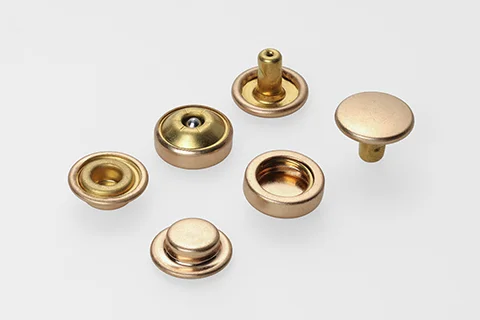
For snap fasteners, tolerance directly controls the pressing force. If the clearance between the male and female halves exceeds the tolerance band, the fastener either fails to lock—coming loose after a single wear—or requires excessive force that deforms the fabric or cracks the riveted assembly. Workers on a production line do not have time to test the feel of every single button. Consistency across the batch is what gets the line through.
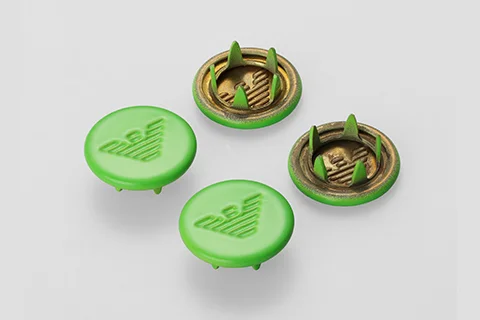
For five-prong buttons, tolerance governs the claw spacing. All five claws need to engage the fabric simultaneously. If the spacing deviates, the fabric either will not enter or catches at an angle. Testing one button in a workshop is easy. Installing several hundred per hour on a line amplifies the cumulative deviation, and the rejection rate on the factory floor will far exceed the numbers from a single-piece lab measurement.
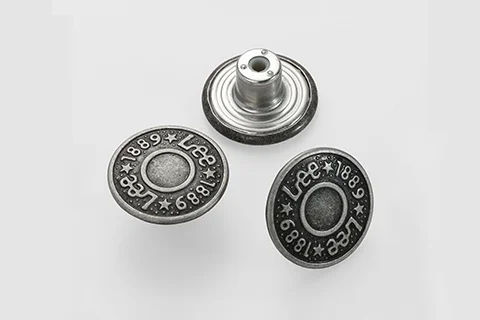
For jeans buttons, tolerance affects riveting strength. Denim is thick, stiff and elastic, demanding far greater fastening force than standard fabrics. If the tolerance on the riveting surface is too wide, the assembled joint carries a gap, and the button pulling free from the fabric under stress is only a matter of time. Specialist hook fasteners are rated at 300 kg pull strength, but that rating assumes the riveting-surface tolerance stays within specification. If the tolerance is off, the number on the test certificate means nothing—because the real-world assembly cannot deliver it.
III. Tolerance is managed, not built into the machine
Tolerance control starts with the mould. Mould precision sets the baseline—whatever deviation exists at the tooling stage is carried into every button pressed from that mould. The precision gap between a mould cut on a standard milling machine and one produced with a CNC machining centre paired with a mirror EDM machine is measured in orders of magnitude.
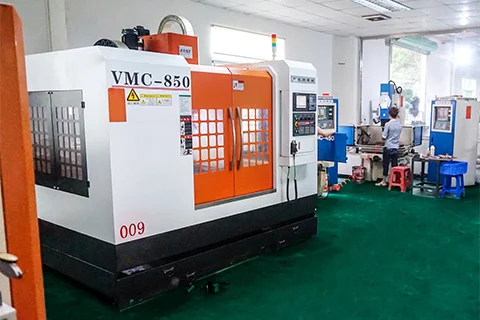
Press stability determines batch-to-batch consistency. Same material, same mould, same press—whether the first button and the last button hold the same tolerance depends on the condition of the equipment and the discipline of the maintenance routine.
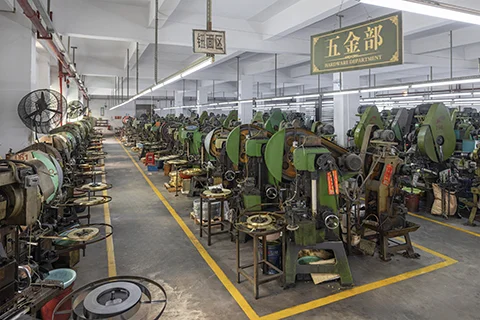
Songji's "one stroke, multiple pieces" process demands more from the mould than standard single-piece stamping. Five-prong buttons come out at eleven per stroke; male-female snap halves at six per stroke. With multiple pieces formed simultaneously, one out-of-tolerance cavity ruins the entire mould run. Many factories avoid this risk by sticking to single-piece stamping—sacrificing throughput to protect precision. Songji runs multi-piece stamping because close to 700 machines, configured and maintained over years across a 12,000 m² facility, provide the precision foundation, and 100-plus patents concentrated in tooling and stamping provide the technical depth. The equipment was not bought in a single push. It was assembled as product lines and client needs evolved, which means the depreciation has already been absorbed.
IV. Is there an international standard for button tolerance
There is no unified international standard for button tolerance. Unlike bearings, which have lookup tables for ISO tolerance grades, button tolerance depends on product category and end use—a pushchair fastener and a fashion button operate at different levels of requirement.
The tolerance standards brands use are, in practice, their own internal acceptance criteria. Brands that have experienced a return set tighter standards. Brands that have not yet been burned may never have considered checking dimensional tolerance on buttons at all. Songji's standards were accumulated across 27 years of serving different brand requirements. They operate within the framework of the ISO 9001:2015 quality management system and have been repeatedly verified through the 72 international brand audits Songji has passed over the past decade. If a standard survives repeated audits by Walmart, GAP, VF and Carhartt, it has been tested from more than one angle.

V. How to assess a supplier's tolerance control
Ask for dimensional inspection reports. Not a verbal assurance that "tolerance is held to 0.05"—look at the actual measured data for a batch. How many samples were taken, what was the deviation on each, and what is the spread between the maximum and minimum values. A complete test report lists every test item, its limit and the measured data. A supplier who hands you a one-word "pass" without numbers behind it is telling you systematic measurement was probably never done.
Run a small-batch trial assembly. Fit the same batch of buttons onto the same garment style. If the feel is consistent, the tolerance is under control. A production-line worker's instinct is sharper than a spreadsheet—if the operator keeps adjusting pressure from one piece to the next, the tolerance spread in that batch is wide.
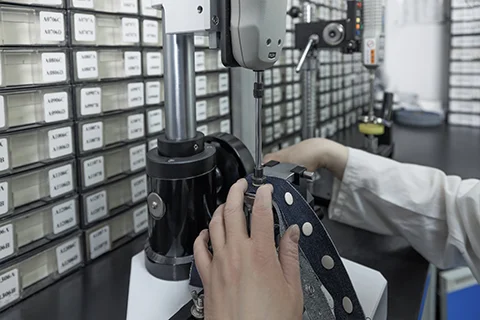
Songji's dimensional inspection is part of the four full-inspection checks run on every batch, alongside tensile strength, salt-spray resistance and heavy metal testing. The defect rate of below 0.3% includes dimensional results. Testing records are retained for at least five years—the tolerance data for a batch produced three years ago is retrievable.

Songji has been making metal buttons since 1999. After 27 years, the process and the inspection regime mean tolerance is not a claim—it is production data. If you need custom metal buttons and want to see whether the measured tolerance data matches your product requirements, get in touch.