If you're a designer or a sourcing manager typing "metal buttons near me" into a search bar, or weighing a local trim shop against a factory on the other side of the world, this guide covers when each route holds up and when it quietly stops working.
Start with one fact that gets skipped: "near me" solves reachability, not distance. You either want the buttons in your hand this afternoon, or you want the fourth production run next year to be identical to the first. Those are two different questions, and they lead to two different supply chains.
This is written from Songji, a metal button factory in Shenzhen that has been making these parts since 1999, so the thresholds and freight terms below are the ones we work with daily.
It also won't argue that everyone should buy from a factory. For a few hundred pieces needed today, with the parts in your hand before you commit, a local shop is the right answer.
I. Reading What Metal Buttons Near Me Offers
Type "metal buttons near me" and what comes back is a map with a handful of shops on it. That map only takes businesses with a physical storefront and a verified address, and a factory in Shenzhen cannot get onto it however wide its range. Not finding one doesn't mean none exists, it means those results are filtered by whether there is a shop, not by whether anyone can make the part.
One case is a real small requirement: sampling, a few dozen pieces to top up a run, a limited capsule, buttons to finish a collection. What that asks for is proximity, ideally a counter you can reach before closing time.
That need gets harder outside a garment district. Trim shops cluster around the wholesale clothing areas of large cities, and a buyer two tiers down opens a map to find three shops within an afternoon's drive, or none at all. Nearby can mean fifty kilometres.
The other is a buyer who typed "near me" out of habit and means something else: is there a person who answers quickly, whose factory I can picture, who is still there when something goes wrong. That search isn't chasing distance, it's chasing accountability.
Reframing the question settles most of it. Are you buying this batch, or the fourth batch a year from now? For one batch, nearer is faster. For a line that runs three years, what decides the outcome isn't distance, it's whether a standard and a batch record exist behind the part.
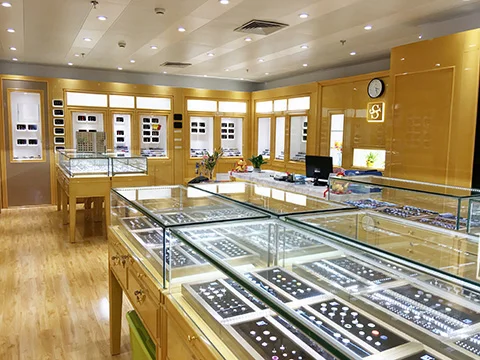
II. Comparing Local Stock with Factory Metal Buttons
Asking where to buy metal buttons for clothing in a garment district returns a short list, and everything on it comes from three layers. The gaps between those layers are wider than the gap in geography.
The retail trim shop is the first one people think of. M&J Trimming in New York is a fair sample: a 5,000 sq ft showroom, more than 100,000 styles, 90 per cent of orders shipped the same day, and a minimum of 12 pieces per colour and size.
The same company description carries a more useful line. The buttons in that showroom come from Italy and the ribbons from France. What is near you is the warehouse, not the production line. The part you handle in a shop has usually crossed an ocean already, with someone else carrying that leg for you.
That physical layer is also thinning. Joann filed for Chapter 11 for the second time in January 2025, announced liquidation of all 800-plus stores in February, and closed the last one on 30 May 2025. Michaels bought the brands and private labels in June and took none of the stores. For anyone counting on a shop nearby, the list of options got shorter in the past year.
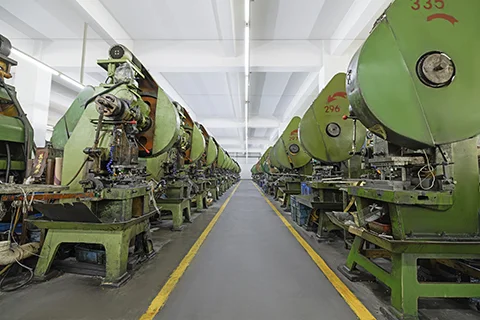
A factory sells scheduling rather than stock. Songji runs a 12,000 sq m plant with close to 700 machines, more than 10,000 styles and around 100 new ones a month, and none of it sits on a shelf. It becomes real only after an order. What a factory can do that a shop cannot is change things: dimensions, lettering, plating, the fit between male and female parts.
Reordering is where the retail route usually slips. A shop's stock follows its importer, and importers change suppliers. The button that sold well last season comes back in the same colour with a different plating batch and a slightly different feel. A shop doesn't make the part, so it cannot promise the next batch matches this one.
Local and factory are therefore not substitutes. They run on different clocks, and metal buttons and garment trims sourced either way end up in the same garment. One solves this week. The other solves the next three years.
III. Sizing Metal Buttons Orders by Quantity
Four variables decide the channel: quantity, number of styles, whether tooling changes, and how soon. Quantity dominates, because it decides whether anyone will take the order at all.
One unit trap needs clearing first. Factories quote in sets, and one snap set is four parts, A, B, C and D, so 5,000 sets is 20,000 pieces. Retail sells in pieces. Compare 5,000 sets against 5,000 pieces and the conclusion will be wrong every time.
Below a few hundred pieces, local wins. A factory's minimum is out of reach at that volume, plate fees have nothing to spread across, and the freight costs more than the buttons.
From roughly 3,000 to 5,000 sets upward, the factory wins. Our thresholds are 5,000 sets for standard plating and spray painting and 3,000 sets for rack plating, with a plate fee of RMB 80 for standard plating, RMB 120 for rack plating and RMB 500 for genuine gold, roughly USD 11 to 70. Those are our own terms, and other factories set very different ones, so ask each supplier separately.
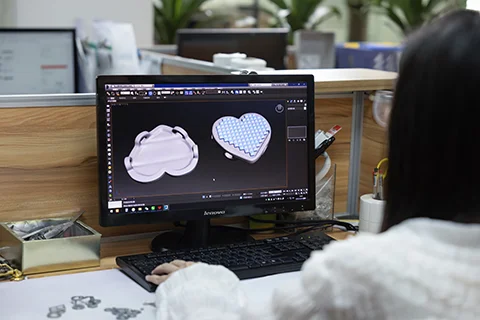
The 500 to 3,000 set band is where most buyers misjudge. Local unit prices are high and a factory minimum isn't met, which leaves neither route comfortable. There is one workable answer: use a tool the factory already has and pay the plate fee only, rather than cutting a new die. Changing the plating colour on an existing part is a different cost structure from opening a die.
The arithmetic on a plate fee is worth doing once. RMB 120 spread over 3,000 sets is RMB 0.04 a set, well under a US cent. The same RMB 120 over 1,000 sets is RMB 0.12, close to two US cents. That is three times as much and still under a tenth of a yuan. The plate fee is rarely the obstacle; volume is. What actually kills a mid-sized order is tooling cost and piece price, not the fee itself.
Colour count is the variable buyers underestimate. Five colours at 600 sets each totals 3,000 sets, which sounds like enough, but factories schedule by colour. Changing colour means flushing the bath and re-approving the first piece, so five colours cost measurably more than one colour at 3,000. Quoting the colour count accurately helps more than inflating the total.
On timing, custom metal button development takes 3 to 5 days with us, so a metal button sample from China is usually ready to ship inside a week, and production runs 14 days for orders up to 500,000 sets in standard finishes. Both figures describe our own capacity rather than an industry norm, and another factory will give you different numbers.
IV. Shipping Metal Buttons After De Minimis Ends
The metal buttons import duty question changed on 29 August 2025, when the United States suspended duty-free treatment for imports valued at 800 dollars or less under Executive Order 14324. Customs and Border Protection's rule is that all shipments up to 2,500 dollars now pay the applicable duty.
That retires a line this trade has repeated for years: send a small parcel first and see. Small parcels used to clear without duty, so trial and error cost almost nothing. It doesn't any more.
The scale of the change shows in the first day's figures. The Universal Postal Union recorded an 81 per cent drop in parcels sent to the United States compared with a week earlier, and 88 postal operators suspended or partly suspended service. CBP separately notes that 95 per cent of low-value shipments already moved through commercial carriers rather than the post, which is where most of the disruption landed.
Two things follow from this.
Samples go by commercial express, DHL, FedEx or UPS, not by postal packet. Declare the value honestly. The duty saved by under-declaring reappears as storage charges and penalties at inspection, plus a record that follows you.
Bulk orders clear as one entry, by air or sea, and the choice is not cosmetic. Ask about metal buttons shipping time from China and there are two answers, because air and sea are not comparable.
Air freight typically lands in 5 to 7 days and sea freight in 25 to 35, with less-than-container loads adding a wait for the box to fill. That difference decides whether your launch date holds. Agree the terms before the first order: FOB, CIF or FCA. Who pays freight, who pays duty, who files the entry. When those three are unclear, the first shipment is where it surfaces, and it has nothing to do with the product. That pattern shows up across metal button projects more often than any manufacturing fault.
The term that gets misread most is where the goods actually stop. CIF and CFR both pay freight to the destination port, not to your warehouse: clearance, duty and the haul from port to your DC all happen after arrival at your local rates, and on plenty of lanes that leg costs more than the ocean freight. CIF also insures at minimum cover, so anything above ICC C is extra. Delivery to the door means DDP, where the seller becomes importer of record and the price structure changes entirely.
V. Verifying Metal Button Suppliers You Never Visit
Knowing how to verify a metal button supplier starts with accepting that the checks change once you cannot walk the floor. Plant tours and machine counts are out, and five things you can confirm at a distance take their place.
The business licence scope. It reads metal products manufacturing, or it reads sales and trading. A scope without manufacturing on it is usually a reseller.
Whether it exports under its own name. A factory with an export licence ships under its own customs declaration, and the consignor and the producer on that document are the same entity. A trader either borrows someone else's declaration or routes the goods through the factory. This one decides whose name ends up on every document you receive.
Whether the test report is an original. Check the laboratory name, the report number, the issue date, and whether the material and finish described match what you are buying. A three-year-old report for a different finish is a common substitute.
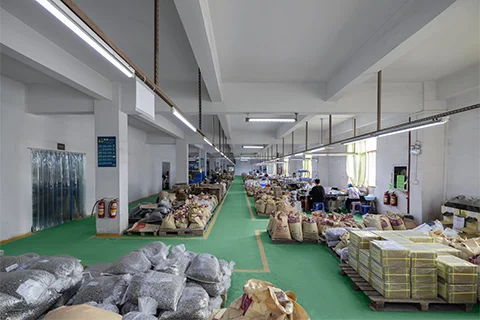
Whether batch files can be pulled. The sharpest test available: pick any order number from two years ago and ask for the full chain within a day, raw material batch, stamping records, plating report, finished goods testing, shipping documents. A factory producing the goods can do it. A trader describes it.
Whether a video walk-through can happen unannounced. A tour booked a week ahead shows a swept floor. A call made at random shows the line that is running.
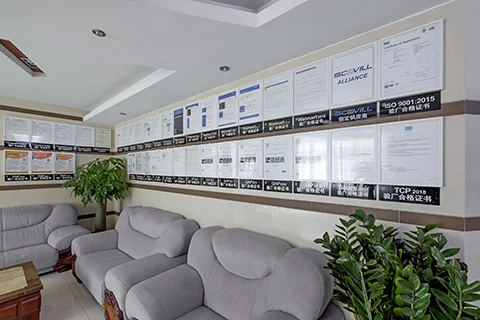
Once those five are done, ask for audit records. We have been through 72 brand audits in the past decade, including Walmart, GAP and VF, and that factory audit record can be requested, or just the section you care about.
Inside the factory the chain runs on numbers: the customer order number, the internal order number, the purchase order and raw material batch number, the warehouse requisition. Four codes run from the order to the finished shipment, each node carrying its own inspection record. Files are kept five years, and any customer request is answered with the full trail within 24 hours.
VI. Choosing Between Stock and Custom Metal Buttons
If the decision is still open, five questions will settle it.
How many in this first order. That single number settles most of it: a few thousand sets points to a factory, a few hundred or fewer points to local stock, and the middle band turns on whether an existing die fits, which is the next question.
Whether an existing tool can be used. If one fits, the tooling cost disappears and an order of a few hundred to 3,000 sets becomes workable.
Which finish and which salt spray level. This drives unit price directly, and it decides whether a local stock substitute exists at all.
When it has to be in the warehouse. Tied to a launch date, stay local. With three to four weeks of slack by air or six to eight by sea, a factory can still make it, counting 14 days of production on top of 5 to 7 days in the air or 25 to 35 on the water, before clearance and collection.
Who handles clearance and duty. If the importer does, add duty to the landed cost before comparing prices, or you are comparing two figures that both exclude tax.

Songji has been making metal buttons in Shenzhen since 1999, now in its 27th year, with a 12,000 sq m plant in Guanlan, Longhua, and close to 700 machines including high-speed presses, CNC and mirror EDM. Five base materials are covered: brass, stainless steel, iron, aluminium and zinc alloy. The range runs across snap fasteners, prong snaps, jeans buttons, shank buttons, rivets, eyelets, trouser hooks, magnetic closures and metal plates, with more than 10,000 styles in stock catalogues and around 100 new ones a month, backed by over 100 national patents. Certifications are ISO 9001:2015, OEKO-TEX Standard 100 Class I and GRS, alongside HIGG FEM and GAP TQP, and the certifications and credentials are current. Customers include NUNA, BMW, PORTS and BURBERRY as well as more than 100 apparel brands on repeat orders, with over 150 standardised quality control steps and a defect rate held below 0.3 per cent.
Buying nearby or buying metal buttons from China comes down to whether you are buying this batch or these three years. Both routes work. The mistake is rarely the channel, it is judging a long run with a short-run measure. If you have a specific quantity and a launch date in front of you, feel free to get in touch.Want to learn more? Contact us.