If you are sourcing metal buttons for a kids' wear line, from bodysuits and sleep bags to bibs and children's denim, this guide covers how to judge whether a Chinese supplier is worth using, and how to design the safety problems out before a test report ever comes back.
I. Layering Safety Requirements for Kids' Metal Buttons
Safety requirements for kids' metal buttons sit in three layers, and collapsing all three into "we are eco-friendly" is the most common sourcing mistake there is.
The first layer is the statutory floor. It sets limits separately for substrate, coating and extractable migration, and the same element does not carry the same number in all three places. Apply one figure to all three situations and the conclusion will be wrong in at least one of them. The second layer is the certification threshold. OEKO-TEX Standard 100 runs four product classes, and only Class I covers babies and toddlers, with total lead set at 90ppm; the test list also covers extractable heavy metals, formaldehyde, pH and colourfastness. The third layer belongs to the supplier. Songji works to an internal lead line of 60ppm. That is our own requirement, tighter than the certification figure, and it is not an industry norm. What another factory holds to is a separate question you have to ask.
One more line gets missed: physical safety. Small parts, pull force and sharp edges are structural judgments, and they run on different logic from chemical compliance. A batch can pass every heavy metal test and still lose a button to a three-year-old's grip, and no chemical report speaks to that. Ask about chemistry and structure separately. One document cannot cover both.
II. Screening Chinese Kids' Wear Metal Button Suppliers
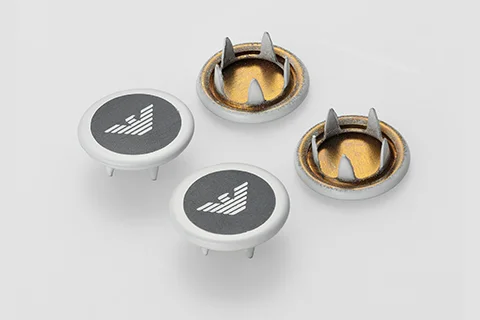
Screening Chinese kids' wear metal button suppliers comes down to three questions: can they say where the limit comes from, can they tie a report to a batch, and can they produce the original records when something goes wrong.
Start with where the limit comes from. When the answer is "we meet environmental standards" or "we are tested", push once more: which standard, which class, which report number. Of the four OEKO-TEX classes only Class I is the baby grade, so a Class II certificate offered for a product worn by under-threes does not hold. In the same way, 90ppm appearing in a certification context does not make it the statutory figure.
Then ask whether the report can be tied to a batch. A report dated 2023 says nothing about the batch shipping in 2026. Have the supplier point to the sample or batch number on the report, then check that number against the delivery note. A report that cannot be matched is a brochure.
The third question is original records. Ours run on four reference numbers that stay with the job throughout: the customer's purchase order, our internal order number, the purchase order and copper batch number, and the warehouse ledger. Any one of them can be traced through the others. Files are held for five years, and a customer asking for the trail gets it within 24 hours. The value of this shows up on the day of a complaint or an inspection, not before. Over the past 10 years we have passed 72 factory audits for international brands, including Walmart, GAP, VF and Carter's, but an audit confirms that a system is running. It does not stand in for the test report on this batch.
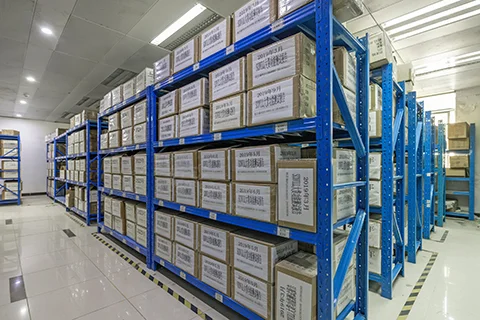
Where a visit is possible, three documents tell you more than a wall of certificates. The incoming inspection report for the copper, with the spectrometer result attached, shows whether the base metal is the grade claimed. The third-party report on each plating bath shows whether heavy metal control is actually happening. The outgoing inspection record shows sampling ratios and accept and reject criteria. All three are produced in the ordinary course of work, which makes them hard to fake consistently over time.
III. Matching Kids' Wear Metal Buttons to Fabrics
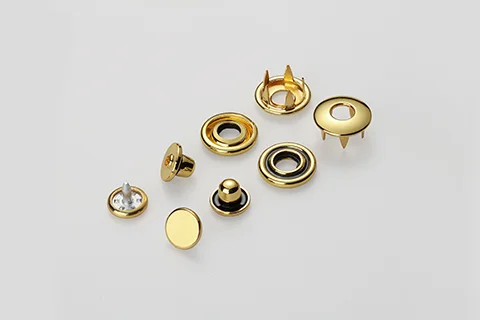
Kids' wear metal buttons fall into four groups: conventional snaps, prong snaps, jeans buttons and shank buttons. The first two close a garment, the last two hold it, and settling that distinction early saves a good deal of rework.
The workhorse for baby wear is the prong snap. Bodysuits, sleep bags and knitted underwear all run on it. There is no hole to punch, five prongs push through the fabric and grip it, and the load pulls perpendicular to the fabric surface, so a thin knit is less likely to tear out. Conventional snaps go on outerwear, padded jackets and denim plackets and waistbands, where the face can carry a logo and the visual weight belongs on that layer.
Jeans buttons are the two-part type: the tack enters from the back, the face presses down and the shank expands mechanically to lock it, and it does not come off once set. The load runs as shear, parallel to the fabric, which is why it belongs on children's denim waistbands and flies. Waistband buttons commonly run 17 to 20mm and flies 14 to 17mm, with children's denim sitting a size smaller. Shank buttons are held by thread, with a shank behind the face so the thread is not cut by the button edge, and on younger sizes the stitching operation needs a backstitch.
Snap opening force is easy to overlook. It is the force needed to open and close the closure repeatedly, and baby wear fails at both ends: too tight and a child cannot manage it, so dressing becomes a parent's job; too loose and it pops open when the child bends or is picked up. Our round spring snaps are made in three opening-force levels, so one model can be specified by position and the placket, waistband and pocket do not have to share a single feel.
Mismatches are common and rarely about appearance. Press a prong snap into padded or coated fabric and the prongs cannot penetrate, the surface looks flat after setting but the grip is not there, and the button works loose after a few washes. Fit a conventional snap to a stretch knit and the fabric cannot carry the weight and pull of the button, so the button position needs interlining or a patch behind it; without one, the ring of fabric around the button goes first. Choosing a type is not a matter of picking a look, it works back from fabric weight, thickness and assembly position. On the baby side we have made hardware for strollers and child car seats, and the cases there carry tighter requirements than apparel, which makes them a useful reference.
IV. Designing Custom Kids' Wear Metal Buttons Safely
Designing custom kids' wear metal buttons is half about removing risk and half about producing the look, and the two are not done in the same order.
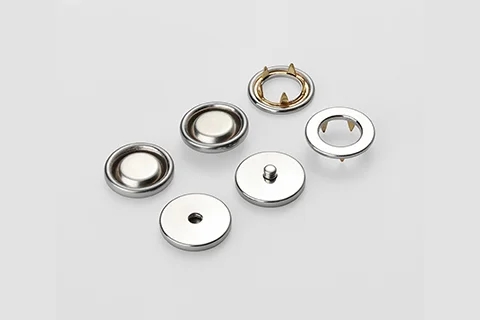
Edge treatment comes first. The outer rim of the face, the prong tips on the back plate and the rolled edge of an eyelet all need rounding and deburring after stamping. Burrs cause two problems in garment production: they snag yarn and cause broken threads, and they scratch skin. The corner radius for a baby size is a different order from an adult size, and it is set at the tooling stage. Grinding after assembly does not put it back.
Pull force cannot be read from a loose part. The same snap behaves differently on a thin knit and on a padded panel, because the fabric deforms before the button does. Ask for testing in the assembled state, with the button set into the actual fabric rather than tested loose. That line in an RFQ is worth more than a Newton figure.
Colour should go through plating rather than painting wherever possible. Paint builds a thick layer, lifts at stressed edges, and babies chew. Vacuum plating is a different class of process: the coating sits around 15μm, the surface is mirror-bright with no micro-pores, which leaves less space for sweat and dirt to collect and makes it easier to wipe clean, and salt spray runs at 5 per cent over 50 hours on our internal standard. A customer specification asking for more has to be assessed part by part, by base metal and structure. Unit price is higher than standard barrel plating, and the difference is quoted by part and by coating type rather than applied as a general multiplier. Logo depth needs control too: too deep and it collects dirt, too shallow and it reads badly. A shallow relief with rounded edges is the safer choice for baby sizes.
Four structural faults turn up most often in kids' wear batches, and they belong on the first-article check. Bent prongs, where the prongs are not set vertical, grip badly and let the whole button pull out, and thin fabric shows this more than thick. A cracked stud, where the ball splits under load and will not hold when pressed, invisible at assembly and obvious after two washes. Petals not cut through, where the eight petals on the back plate were not slit far enough and the setting is loose from the start. Over-height parts, where the total height exceeds what an automatic button attaching machine will accept, forcing hand setting and costing the garment factory both speed and consistency. All four are tooling and stamping problems. None of them appear on a test report, and the only place to catch them is first-article approval, in-process inspection and batch inspection.
Nickel needs precise wording. Meeting the nickel release limit is not the same as being nickel-free, and an iron base metal cannot be protected without a copper-nickel-chrome stack, so nickel sits in the coating. Write "nickel release held within the limit", not "nickel-free", because the two are not the same thing in law. What has to be controlled is the release test, not the name of the material.
Custom development has three things to settle before tooling: fabric specification, assembly method and target-market regulation. Any one of them arriving late becomes a tooling change, and a tooling change costs far more time than getting it right the first time.
V. Reading Kids' Wear Metal Button Test Reports
A test report for kids' wear metal buttons is judged less on how many lines it carries than on whether it can be tied to the batch in front of you.
OEKO-TEX Class I is the threshold most often asked for on baby product, and it covers extractable heavy metals, formaldehyde, pH and colourfastness, usually with a one-year validity. Validity is not permanence. A change of plating process, a change of base metal batch or a change of coating type all call for retesting. The one buyers miss is the batch change: the report is still in date while the product has already moved.
Our answer is to send every plating bath for third-party heavy metal testing and file the result against the batch. It sounds laborious, and it turns "this batch is the same as the last one" from a promise into a record. Paired with the four reference numbers, any batch can be traced back to a specific bath.
Needle detection is particular to children's wear. Metal parts set off a needle detector, so the process has to separate them rather than expecting a full carton to pass through. There are two common routes: pack the buttons separately and scan the fabric side by area, or assemble first and scan by component. Either way, the needle detection work instruction and the packing detection record stay on file, because the record evidences the operation and the responsibility, not just a clean result.
The Carter's baby programme is a reasonable reference point. What we make for that line is nickel-free stainless steel paired with high-purity brass, rounded and passivated, to OEKO-TEX Class I, with low-sensitivity testing, a report and traceability code with every batch, and data held beyond five years. That line has passed audits for 10 consecutive years. Our ISO 9001, OEKO-TEX Class I and GRS certifications are all current.
VI. Sampling and Ordering Kids' Wear Metal Buttons
Sampling kids' wear metal buttons usually takes three to five days, and the slow part is the confirmation round rather than the sample itself.
Five parameters go with a sampling request: fabric weight and thickness, assembly position, target market, colour method, meaning plated or painted, and the logo file. Leave one out and the sample will most likely be unusable, and a round trip costs a week. Where an existing size only needs a logo added, around 30 samples can be arranged for confirmation. New tooling is quoted separately.
Minimum order quantities follow part type and process. Established categories start at 5,000 sets for standard plating or painting, 3,000 sets for standard barrel plating and 3,000 sets for real gold plating. The mould fee is a one-off and is not repeated on reorders. The plate fee is tied to the size of the order and is charged only when the quantity falls short of the minimum, not when it clears it. These are Songji's thresholds. Other factories differ widely, some starting at 10,000 sets, some taking a few hundred, so the question has to be asked against your own volumes.
Kids' wear orders tend to run many colours at low volume per colour. Five colourways of one style are plated separately, and the batch numbers have to be recorded separately too, or the traceability chain breaks at the colour step. Settle this when the order is placed; it cannot be reconstructed after shipment.
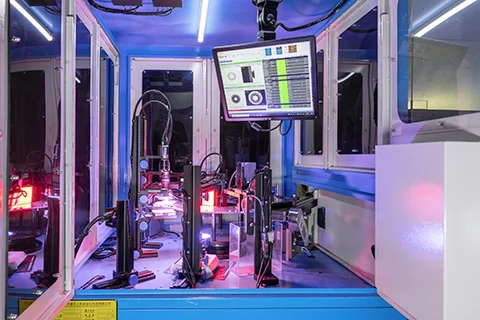
Lead time runs 14 days for orders up to 500,000 sets in standard processes and colours. We work in Guanlan, Longhua, Shenzhen, on a 12,000 square metre site with close to 700 machines, including high-speed presses, CNC and mirror EDM, and we handle copper, stainless steel, iron, aluminium and zinc alloy. The range covers snap fasteners, jeans buttons, rivets, eyelets, prong snaps, trouser hooks, shank buttons, magnetic closures and metal badges, with more than 10,000 styles available and around a hundred new ones added each month, backed by over 100 national patents. More than 100 apparel brands use our parts, along with bag and stroller programmes, some of which appear in our cases. Songji has made metal buttons in Shenzhen since 1999, which makes 2026 our 27th year.
On kids' wear, the hard part has never been making an attractive button. It is being able to answer the inspection that arrives ten years later. If there is a specific part you need to settle, get in touch.Want to learn more? Contact us.