If you're a product developer or a sourcing manager buying metal buttons for outdoor gear, whether that means tents, packs, shells or hiking boots, this guide covers what the salt spray hours in your quotes can and cannot tell you, and which material and design decisions still matter three years later.
I. Tracing Where Outdoor Metal Button Corrosion Starts
Outdoor gear metal buttons rarely fail on the face you check when the sample arrives. Rust starts at cut edges, at folded seams, and in the ring where the button presses down on fabric. Water gets into that ring and stays. Oxygen levels differ inside and outside the gap, crevice corrosion begins, and the visible face is still bright while it happens. How well the surface was finished matters less than whether a gap exists.
A thickness gauge can read correctly while a cross-section shows bare base metal at the fold. Thickness is an average, and edges, deep holes and blind holes are where current density runs low, so plating is thin there by default. Our vacuum plating runs at about 15μm with ±1μm variation, three passes or more, to close the pores. That figure is our own control line, not an industry threshold.
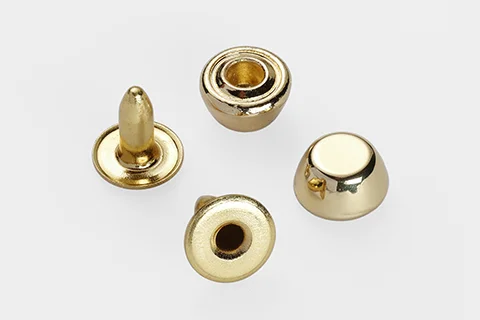
Hollow rivets and eyelets hold water. So does the spring cavity inside a snap, and the gap under the edge of a metal plate on a pack. Two metal button parts from one batch look identical, and one goes onto a panel that drains while the other goes onto a pocket that pools.
Washing opens a second front. Mud, sweat and sunscreen all sit near the button, and the salt and lactic acid in sweat attack plating where it meets fabric. A tumble cycle rubs the part against lining for hours, wearing thin areas down to base metal before any corrosion begins. A salt spray report covers one of those three.
II. Choosing Corrosion Resistant Metal Buttons by Material
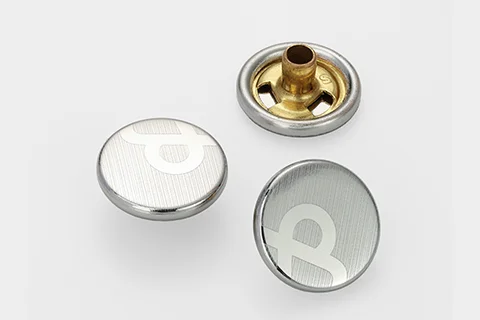
Corrosion resistant metal buttons come down to stainless steel or copper alloy first, with die-cast zinc after that. The order follows how each one fails rather than what each one costs.
316 stainless carries 2 to 3 per cent molybdenum, which resists chloride pitting better than 304, so it earns its place on coastal kit, alpine kit and anything worn against skin. The cost sits in machining: 316 work-hardens quickly, wears dies faster than brass and shortens tool life. 304 covers most general outdoor use at a lower price. Copper alloy goes another way, tarnishing outdoors without losing structural strength and holding up far better than zinc at sea.
Die-cast zinc is cheap, takes complex faces and fine logos, and dominates indoor apparel and bags. Left outdoors, it depends on the coating system for protection and should not carry structural load. Aluminium needs anodising, since bare aluminium pits quickly around chlorides. Where copper is specified, H65 brass is the grade we run most, at 65 per cent copper, and it takes plating evenly across a drawn part.
At Songji, both copper and stainless take vacuum plating, and our in-house salt spray figure is a 5% solution for 50 hours. Anything above that is assessed case by case, because the answer depends on the base metal and the geometry. Our ISO 9001, OEKO-TEX and GRS certifications are all current.
III. Avoiding Galvanic Corrosion on Metal Button Assemblies
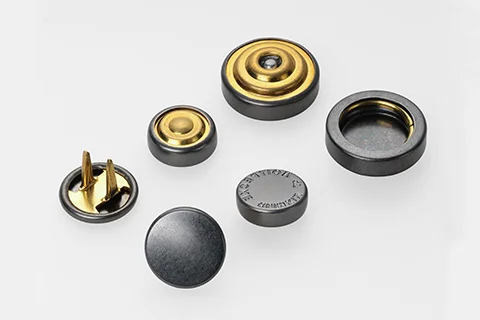
Galvanic corrosion on metal buttons is the one buyers tend to miss. A part can pass a lab test on its own and still rust on the finished piece, because what happens to it depends on the rivet fitted beside it.
Three conditions have to line up: two metals at different potentials, an electrolyte, and direct contact. Rain, seawater and sweat all act as electrolytes, and outdoor gear supplies all three without trying. Copper alloy against stainless gives a small potential difference and a lower risk. Zinc against stainless, or an aluminium frame with stainless eyelets, is where it turns visible.
Area ratio matters more than the potential gap. A small anode facing a large cathode corrodes fast, so a zinc rivet through a stainless panel fails at the rivet sooner than the same zinc part would fail alone. Turn the ratio around, a large zinc face with one small stainless rivet, and the rivet survives while white rust blooms across the zinc.
The simplest fix is to stay inside one material family, with button, rivet and washer all in copper or all in stainless. Where mixing cannot be avoided, insulate with a nylon washer, a local coating or an anodised layer. Adding mass to the anode buys time as well.
A boot is a compact version of the problem. Eyelets, hooks and lace hardware often end up in three different metals, all wet for hours at a stretch, and the failure shows up at the smallest part in the chain.
One line worth adding to a request for quotation: test in the assembled state, not on loose parts. A single part can pass and still rust within a year once it is set into fabric.
Setting force carries some of the blame here. Pressed too hard at the machine, the plating cracks along the clinch and base metal is exposed from the first day of service.
IV. Reading a Metal Button Salt Spray Report
A metal button salt spray test report should be read for its conditions first and its hours second. Reverse the order and the hours mean very little.
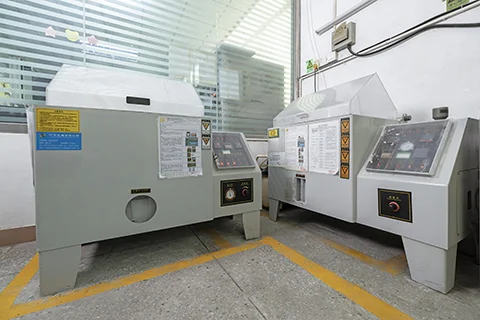
The conditions are fixed: 5% sodium chloride solution, chamber at 35±2°C, pH between 6.5 and 7.2, and a fall-out rate of 1 to 2 ml per 80 cm² per hour. ASTM B117 and ISO 9227 neutral salt spray agree on all four, so a report that does not match them can be set aside. Duration is the part the standard leaves open. B117 does not state how long to run, and the figure comes from the product specification instead, commonly 24 hours to a few hundred, with harsher applications running into four figures.
B117 also carries a limit that few quotes mention. Neutral salt spray correlates poorly with behaviour in natural environments and cannot predict service life unless long-term atmospheric exposure data backs it up. The chamber stays wet throughout; the real world dries out, gets rained on and changes temperature. Converting hours into years, the familiar "1,000 hours equals X years", has no technical basis. Ask for the exposure data behind it.
Four things decide whether a report is usable. Whether the parts were tested loose or assembled. What the pass criterion was: first rust, percentage of affected area, or creep from a scribe. Which rating method was applied, ASTM D1654 for scribe creep, D714 for blistering, B537 for electroplated coatings. And whether the report ties back to a batch number and sample ID. Without those four, a large number is still just a number. A report from the supplier's own lab is worth reading, though a third-party report settles the question of who did the measuring.
Where the service environment is genuinely severe, ask about cyclic testing. ASTM G85 Prohesion, SAE J2334 and ISO 12944-9 all alternate wet and dry, which tracks real exposure better than continuous fog. They also take longer and cost more, so they usually go on critical parts only.
V. Designing Custom Metal Buttons for Outdoor Gear
Custom metal buttons for outdoor gear get reviewed for drainage before anyone discusses shape. If the water has nowhere to go, how the part looks is irrelevant.
The moves are simple. Radii instead of sharp corners, no closed blind holes, a drainage channel on the hidden face, and an eyelet flange that grips the fabric rather than only itself. Radii solve a plating problem too, since sharp corners concentrate current and produce an uneven deposit, and they are the first place to chip through to base metal.
Logo depth needs its own decision. Press too deep and dirt collects, darkening the recess after a few washes. Press too shallow and a mirror-like vacuum plated face reflects it out of sight. The boundary between the two only shows up in a sample.
Opening force gets overlooked on outdoor kit. Gloved hands feel very different from bare ones, which argues for a lighter snap, except that a light snap pops open in a side pocket that gets squeezed. Opening force can be graded, and our round snaps run three levels so a position can take the force it needs.
Grommets for tents and tarps are a different part. Hole size cannot be set from cord diameter alone, because fabric thickness and flange height belong in the same decision. A flange that does not grip the plies means the fabric tears before the eyelet fails. Custom development for these starts from the fabric specification rather than from the nearest stock hole.
Waterproof fabric adds one more problem. Punching a shell, a fly sheet or a dry bag cuts the membrane, and water then travels along the plies rather than through the eyelet. The fix usually sits on the assembly side: seam tape behind the hole, a gasket washer, or a position where water does not pool. All three need settling with the fabric supplier before the tool is cut.
Tooling is charged once and not repeated on reorders, and sampling runs 3 to 5 days. Vacuum plating costs more per piece than rack plating, with the difference quoted against the part and the finish rather than a standard multiplier. We have done outdoor and bag hardware of this kind before.
VI. Verifying Corrosion Resistance in Metal Button Batches
Corrosion resistance in metal buttons is settled at batch level. A passing sample only gets a part through the door, and a second run from the same tool can come out one grade below the first.
The cause usually sits in the process rather than the recipe. Bath chemistry shifts as metal ions build up, jig position decides how current spreads across the work, and incomplete pre-treatment leaves an oil film behind. Any one of the three lifts porosity, and a part measured at the same 15μm fails sooner if it has more pores.
We turn those steps into paperwork. Every plating bath is sampled and sent to a third party for heavy metal testing, with the report filed against the batch. The customer order number, our internal order number, the raw material batch and the plating return batch can be traced against each other. Files are kept for five years, and a customer asking for the trail gets it within 24 hours. Alongside that, each run carries a first-article report, in-process checks and a final inspection against the drawing, which is how a plating drift gets caught before it reaches a carton. Quality control runs through more than 150 standardised checks, and the defect rate sits below 0.3%. Over the past 10 years we have passed 72 factory audits for international brands, including Walmart, GAP and VF.

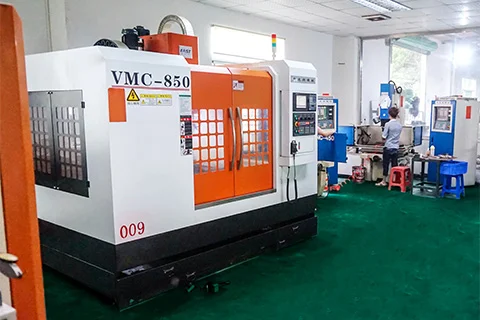
Songji has made metal buttons in Shenzhen since 1999, which makes 2026 our 27th year. The factory in Guanlan, Longhua covers 12,000 m² with close to 700 machines, among them high-speed presses, CNC and mirror EDM, and works copper, stainless steel, iron, aluminium and zinc alloy. The range covers snap fasteners, prong snaps, jeans buttons, shank buttons, rivets, eyelets, trouser hooks, magnetic snaps and metal plates, with more than 10,000 styles on the books and around a hundred added each month. We hold over 100 national patents, plus HIGG FEM and GAP TQP alongside the certifications above. Brands including NUNA, BMW, PORTS and BURBERRY sit on the customer list, together with long-running orders from more than 100 apparel brands.
Whether the button beside the zip still opens in three years says more about a part than the salt spray figure on the quotation. If you have a piece in development and the material is still open, it is worth talking through early.Want to learn more? Contact us.