Most fashion brands placing their first order for custom metal buttons worry less about quality and more about quantity. A young label might make only a few hundred garments for one style, which means a few thousand button sets — a quantity many factories will not even switch on a press for. Songji has made metal buttons and garment hardware for 27 years, and we have handled a lot of first orders from small brands, so we know exactly what a low MOQ means to a fashion label: a way to test a design cheaply before committing to scale. If you are a fashion brand looking for a metal button factory that will take a small order without cutting corners on it, this guide walks you through our minimum order quantity (MOQ) rules and the metal button prototyping process.
I. Why Fashion Brands Need a Low Button MOQ
Fashion labels and independent designer brands share one trait: styles turn over fast, but each style sells in small runs. On a first drop, no one knows how much will sell, so a warehouse full of buttons and trims is a cash-flow risk. A low MOQ is not about saving a few yuan; it is the ticket to testing a design in the market without committing to bulk.
The difference from traditional garment manufacturers is the order shape. A classic mass-producer runs few styles at huge volume, so a 10,000-set MOQ costs them nothing. A fashion brand runs many styles at small volume and reorders quickly, so it needs a supplier whose minimums bend to that rhythm — otherwise every new style becomes a fresh negotiation.
We have watched plenty of brands order trims for just a few hundred garments on their first round, using that small run to read the market before deciding whether to reorder. For a factory, orders like that are not profitable on their own — but they test whether the factory is willing to grow with the brand, which is exactly why we take them.
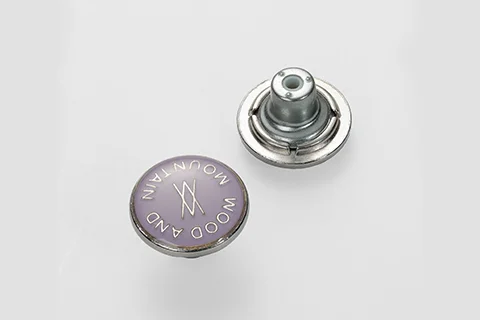
II. What a Low Metal Button MOQ Means
Our MOQ for mature products is set by finishing process, not one flat number. Standard electroplating and standard spray painting start at 5,000 sets. Standard rack plating and genuine-gold rack plating start at 3,000 sets.
The gap between 3,000 and 5,000 comes down to how the finishing line runs. Electroplating and spray painting are batch processes, so they are efficient only above a certain volume; rack plating hangs each part on a rack and plates it individually, so it stays economical at smaller runs. That is why rack plating is the natural fit for a fashion brand's first small order.
That 3,000-set floor is low for the metal button industry, where many large factories set a regular MOQ of 10,000 sets or more. If an order still falls short of our MOQ, we have a fallback: a small batch fee that lets the order go ahead anyway. So "low MOQ" at Songji works two ways — our regular MOQ sits below the industry norm, and when you are below it, the batch fee mechanism still lets the order happen.
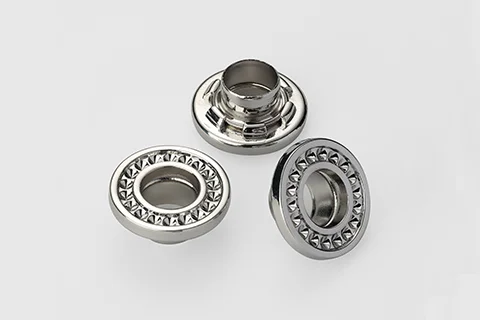
III. Free Samples and Metal Button Prototyping
The most brand-friendly part is the sample stage. If you pick an existing size of jeans button, snap fastener or prong snap and only add your logo, we charge a logo development fee and provide about 30 free sample sets for you to check. The samples exist for one reason: to let you see your own logo stamped on a metal button before mass production, so you can judge whether it is sharp, whether the relief stands out and whether the colour is right.
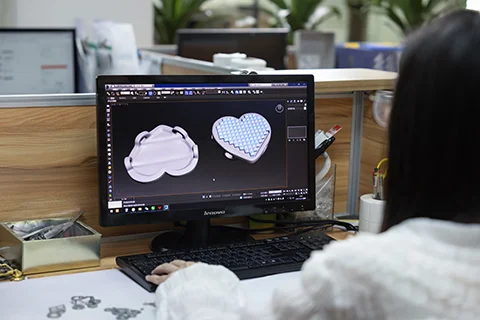
When you look at the samples, check three things: whether the logo is sharp rather than fuzzy, whether the relief has depth rather than looking flat, and whether the colour matches your reference. A logo that is crisp on screen can still turn fuzzy on a metal button, because the artwork has to be rebuilt for a stamping die.
The metal button prototyping process runs fast here. Samples come out in three to five days, and once the artwork and finishing are confirmed, the first version usually lands right without back-and-forth.
IV. Batch Fees That Keep Small Orders Viable
People often misread the batch fee as a penalty on small orders. It is actually a flexible mechanism. For a mature product that has already been developed, every order — including repeat orders — that falls below the MOQ carries a batch fee; hit the MOQ and the fee disappears entirely.
The fee scales by process: standard electroplating and spray painting run RMB 80 (about USD 11) below MOQ, standard rack plating RMB 120 (about USD 17), and genuine-gold rack plating RMB 500 (about USD 69). In practice, if you only want 2,000 sets to test the water, the order still goes to production as long as you accept that fee.
Do not confuse the batch fee with the mould fee. The batch fee is a per-order charge that applies whenever you miss the MOQ, including repeat orders; the mould fee is the one-time cost of developing your logo in the first place. They are separate and serve different purposes.
V. One-Time Mould Fees for Custom Metal Buttons
A custom logo needs a mould, and that development cost is a one-time charge. It splits by material and type: copper jeans buttons, snap fasteners and rivets cost RMB 350 (about USD 49) for the mould; the same parts in alloy cost RMB 800 (about USD 111); shank buttons cost RMB 1,000 (about USD 139). Special or complex shapes are quoted separately.
The price gap between copper and alloy comes from how each is formed. Copper parts are stamped from sheet, so the die is simpler; alloy parts are die-cast by melting and injecting the metal, which makes the mould more expensive to build and maintain. Shank buttons cost more still because their shank adds another forming step.
The key word is "one-time". Pay the mould fee once and repeat orders never charge it again; only when a repeat order falls below MOQ does the batch fee from the previous section apply. For a brand that reorders often, the mould cost amortises quickly.
VI. From Metal Button Sample to Mass Production
Passing the sample is only the first step. Whether mass production can match the sample is what actually tests a factory, and Songji leans on standardised process: a routine order of up to 500,000 sets in standard process and colour ships in 14 days, and the full-batch defect rate stays below 0.3%.
For electroplated products on leather that go through enzyme washing, we test to a 5% concentration for 50 hours in salt spray, so the finish survives the wash without fading. On top of that, we have passed 72 audits from international brands over the past 10 years. For delivery, orders over RMB 5,000 (about USD 694) ship to a logistics point near you at our cost.
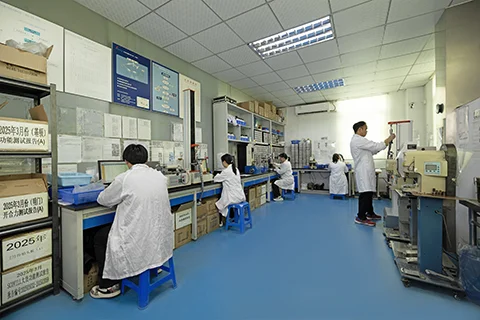
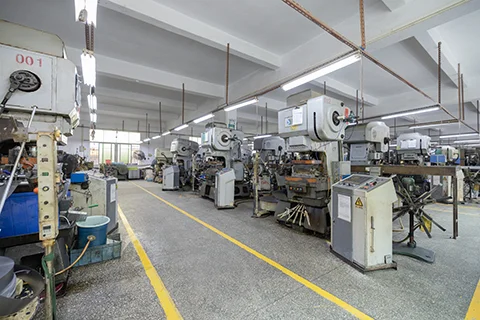
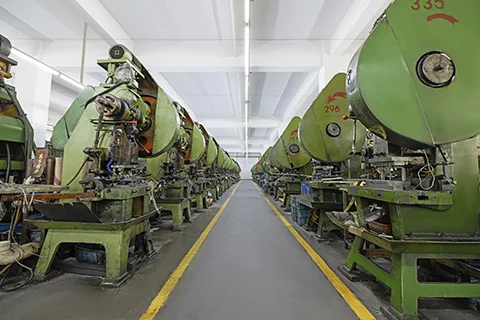
Songji is based in Guanlan, Longhua, Shenzhen, with a 12,000-square-metre factory and nearly 700 machines covering high-speed automatic presses, CNC machining centres and mirror-spark machines, a low-MOQ custom metal button manufacturer and source factory for garment hardware for 27 years. The product line covers metal buttons, snap fasteners, prong snaps, jeans buttons, shank buttons, rivets, eyelets and metal badges, in copper, stainless steel, iron, aluminium and alloy, with more than 10,000 styles. The factory holds ISO 9001:2015, OEKO-TEX Class I and GRS certification, has passed 72 audits from international brands over the past 10 years, and has long supplied metal buttons and trims to Walmart, GAP, LEE and Carter's. If you are a fashion brand looking for a metal button factory willing to walk with you from 30 samples to mass production, we would be glad to talk. Want to learn more? Contact us.