Metal buttons are not one product but an entire category. Snap fasteners, prong snaps, jeans buttons, shank buttons, rivets and eyelets all share the metal button name, yet each is fitted differently, takes load differently and suits a different fabric. Pick the wrong type and, at best, a button falls off or a thread gets cut; at worst, a whole batch fails needle detection and a factory audit. Songji has made metal buttons and garment hardware for 27 years, and in that time we have watched too many orders fall at the first step, because the type was never right. If you are a clothing brand or garment manufacturer sourcing metal buttons for garments and wanting to tell the types of metal buttons apart, this guide walks you through the main garment metal buttons and how to match each one to your fabric.
I. Why Metal Button Type Matters for Garments
Metal buttons split into four functional lines: closure parts have male and female halves that open and close repeatedly; fixed parts do not open themselves but work with a buttonhole; reinforcement parts hold the load at stress points; decorative parts exist for looks. These four lines cannot be swapped.
The difference shows fastest in how a button closes. A snap fastener closes through a spring grip between its stud and socket, while a jeans button and a shank button close through a buttonhole. The first is a closure structure, the second a fixed structure; their load direction and their way of failing are nothing alike. Get the type wrong and the button will not hold.
Decorative parts, the fourth line, are the easiest to confuse with the other three because they look like fasteners. A metal badge, a hook or a buckle does not close or reinforce anything; it is there to carry a logo or finish a look. Treating a decorative part as a load-bearing part is a common, and expensive, mix-up.
The type also decides whether a batch passes needle detection. Iron parts fail a magnetic needle detector, so orders bound for Japan and Western markets are blocked outright. We have watched too many buyers compare prices first, only to meet the needle detector at the end with the whole order stuck. The first step is not the price; it is getting the type right. Get the type right and the next question is the material, because type and material work together: a snap fastener in the right type but the wrong metal will still fail the same market.
II. Snap Fasteners Versus Fixed Buttons
Start with closure parts, which carry their own male and female halves and open and close repeatedly. The most common is the snap fastener, made of a cap, a socket, a stud and a post, with the socket's spring gripping the stud. It comes in two forms: the S-type spring, gentler and suited to mid-to-light fabrics such as down jackets and outerwear, and the O-type ring spring, which grips harder and holds more tensile strength for heavy materials such as canvas and strollers. Songji's mainstay is exactly these two types, stamped in a one-shot multi-cavity process that holds the stud and socket to a functional tolerance of ±0.025 millimetres, which is what keeps the open-close feel steady. A prong snap is a type of snap fastener: it keeps the same four parts but replaces the base with five prongs that pierce the fabric and grip it directly, with no pre-punched hole, which makes it the choice for babywear, knitted underwear and other thin fabrics.
When to pick a prong snap over a standard snap fastener post comes down to the fabric. A prong snap's five claws grip a thin knit without tearing it, and because no hole is punched first, the raw edge stays intact; on a dense woven that needs a firmer seat, a standard post is the safer call. Matching the base to the cloth is a detail that separates a smooth run from a batch of torn buttonholes.
A fixed button cannot open and close on its own and has to work with a buttonhole. A jeans button is a two-part fitting, a button face and a tack driven through from the back and locked onto the waistband, closing through a buttonhole; on a waistband a jeans button commonly runs 17 to 20 millimetres, with the fly button a size down. A shank button carries a loop or shank on its underside, is sewn onto the placket and also closes through a buttonhole, which is why coats, suits and outerwear all rely on it. The shank is the part that matters most: it is what keeps the sewing thread clear of the metal edge, so the thread does not get cut, which is how a button stays on a coat for years instead of dropping off.
The essential difference is one line: a closure part opens and closes on its own, a fixed part needs a buttonhole. In practice that is the difference between snap fasteners and jeans buttons, and getting it right is the first sorting step. Confirm which one your fabric and construction call for before you source.
III. Rivets and Eyelets: Reinforcement Hardware
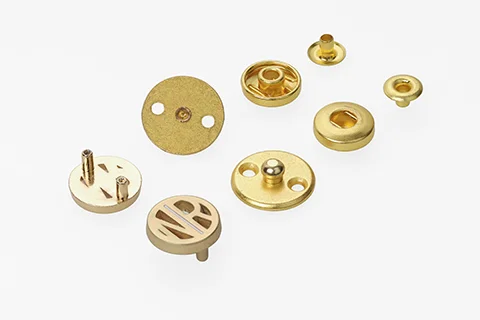
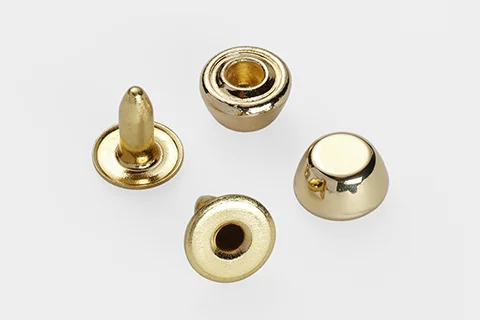
Reinforcement hardware is not for fastening but for taking load and running cords. A rivet is a two-part fastener pinned at the points most likely to burst, such as jean pocket corners and stressed seams. It has been reinforcing workwear for over a century and is still standard on every pair of jeans today. An eyelet has a hole in the middle for laces and drawcords, and also appears on hat brims, hoodie drawcord holes and truck tarpaulins, working as both a functional and a decorative part.
Neither opens and closes, but when one lets go it causes more trouble than a lost button: a fallen rivet means a stress point has given way, and a fallen eyelet leaves an open tear. There is a trick in testing rivets most reports keep quiet about: the same rivet gives a different pull figure depending on whether it is pulled sideways or straight. A factory that has run both knows which direction reflects the real load, and whether a report names its direction is a fast way to judge how trustworthy it is.
IV. Metal Button Materials and Compliance
The material decides both durability and whether an order can be exported. Brass is the classic, with a golden finish, strong corrosion resistance and room for an engraved logo, which is why suits and coats use it. Zinc alloy is die-cast into complex reliefs and three-dimensional logos, making it the mainstay of custom designs. Stainless steel resists rust and suits outdoor and workwear use. Aluminium is the lightest, used for lightweight designs. Stainless steel earns its place the moment corrosion enters the brief: it weathers salt spray far better than plated iron, which is why marine, outdoor and heavy-wash garments lean on it even though it costs more to work.
Brass and zinc alloy often compete for the same custom job, and the choice is a trade-off. Brass takes a cleaner engraved logo and holds a truer golden finish, but it costs more; zinc alloy shapes complex three-dimensional reliefs more cheaply, but its surface is softer. For a logo that has to stay sharp after years of wear, brass wins; for a bold relief on a budget, alloy does the job.
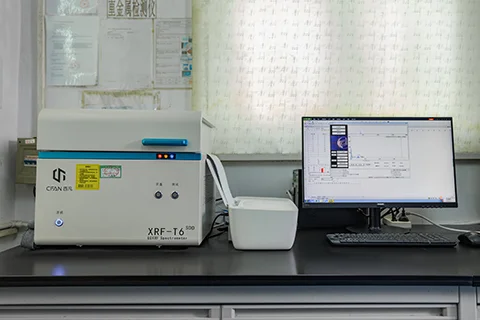
Iron is strong in tension, ductile and cheap, but it carries two hard limits. First, its plating must use nickel as a base layer, so it cannot take a nickel-free finish. Second, it fails magnetic needle detection, so orders bound for Japan and Western markets mostly rule it out. Material, then, cannot be judged on price alone; the target market comes first. Our practice is to run raw material through a spectrometer and a heavy-metal analyser the moment it enters the plant, keeping heavy metals within 40 ppm, tighter than the 90 ppm limit of OEKO-TEX Class I, before deciding which market that batch can serve. Ask the target market first, then settle the material; reverse the order and everything downstream gets harder.
V. Metal Button Sizes and Finishes
Once the type and material are right, size and finish are the last matching step. The broad rule is heavy fabric takes a bigger button and light fabric a smaller one: a jeans button on a waistband commonly runs 17 to 20 millimetres, while thin fabrics such as shirting sit better with small buttons of 9 to 15 millimetres. The finish sets the grade and the wear: antique brass and aged finishes read vintage; gunmetal and matte black read modern and low-key; bright nickel and mirror finishes read premium; enamel filling reads custom.
Gunmetal and matte black sit naturally on workwear and technical garments, where a bright finish would look out of place and show scratches faster, and a matte surface hides minor wear better.
Antique brass and aged finishes are not just a colour; they come from an oxidation treatment that has to be matched across the buttons, rivets and eyelets in one order. Get the tone slightly off between batches and the difference shows the moment a garment is laid out under shop lighting. This is the detail buyers overlook most, yet it affects the look of the finished garment the most.
Tolerance is where precision manufacturing shows: ±0.05 millimetres for standard parts and ±0.025 millimetres for functional parts is the dividing line, and it decides whether a button fits loose and whether the open-close feel stays consistent. Corrosion resistance is graded too: standard buttons are tested at 1% salt-spray concentration for 24 hours, while luxury garment accessories go up to 5% for 50 hours, so a buyer has to ask which tier their order should be tested against.

VI. How to Choose Metal Buttons: A Sourcing Checklist
Whatever the type of garment metal button, four things have to be asked through to the end. First, is it a closure or a fixed part, and does the structure match your fabric and construction.
Second, can the material pass the needle-detection and nickel-free requirements of your target market. Third, does the tolerance hold steady, at ±0.05 millimetres for standard parts and ±0.025 millimetres for functional parts. Fourth, is the paperwork complete, with pull, salt-spray and heavy-metal reports available batch by batch. Ask these four clearly, get the type right, and mass production will run smoothly from there.
Songji sets its snap fastener pull strength at no less than 35 kilograms, with special hooks reaching 300 kilograms, and keeps test records for at least five years per batch, so every batch points back to its own report. Put these four questions to a supplier and the difference between one who answers and one who hedges shows at once. None of this has to wait for mass production: a single pre-production sample tells a buyer whether the type, material, size and finish all line up, and it is far cheaper to catch a mismatch on one sample than on ten thousand buttons.
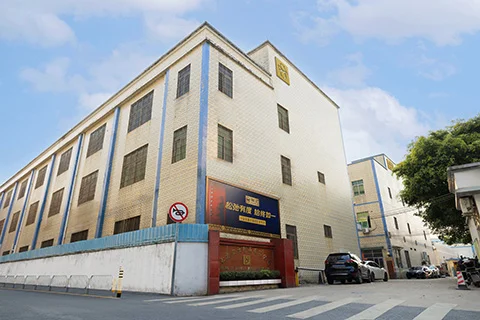
Songji is based in Guanlan, Longhua, Shenzhen, with a 12,000-square-metre factory and nearly 700 machines covering high-speed automatic presses, CNC machining centres and mirror-spark machines. It is a source factory that has focused on custom metal buttons and garment hardware for 27 years. The product line covers metal buttons, snap fasteners, prong snaps, jeans buttons, tack buttons, shank buttons, rivets, metal badges, hooks and belt buckles, in copper, stainless steel, iron, aluminium and alloy, with more than 10,000 styles, so a single factory can handle every piece of hardware on one garment line. The factory holds ISO 9001:2015, OEKO-TEX Standard 100 Class I and GRS certification, has passed 72 audits from international brands over the past 10 years, and has long supplied metal buttons and accessories to brands such as Walmart, GAP, LEE and Carter's, keeping its full-batch defect rate below 0.3%. If you are choosing custom metal buttons for an apparel line, we would be glad to talk.
Want to learn more? Contact us.