The most common question buyers ask when sourcing metal buttons in China is "can you do custom work". The better question is "how far can you take a custom order". Getting OEM and ODM mixed up, sending incomplete specifications, and failing to lock down quality-control figures before production are the three most common sources of rework. Songji has done custom metal button manufacturing for 27 years, and in that time we have watched too many buyers skip a few questions up front and pay for it in production and delivery. If you are a fashion brand or trading company sourcing OEM and ODM metal buttons from China, this B2B checklist walks you through every step before you place the order.
I. OEM Versus ODM Metal Buttons: Know the Difference
Before you commission custom metal buttons, sort out OEM from ODM. OEM is contract manufacturing: you supply the design, the logo and the material spec, and the factory builds exactly that. ODM is design manufacturing: the factory offers ready styles or design options, and you pick one and put your own brand on it.
Neither is better, but they point in opposite directions. OEM tests a factory's execution precision, while ODM tests its design depth and its style library. We have seen buyers place an OEM order with a factory that only does ODM selection, only to find it has neither the matching tooling nor the will to open a mould for a small run, wasting a whole season. Ask which one the factory actually does before you commit.
Which one fits you depends on where your design sits. OEM metal buttons suit a brand that already has a finished design and a logo, and needs the factory to reproduce it exactly. ODM metal buttons suit a brand that wants to move fast, picking from a factory's existing styles instead of waiting for a new mould. Knowing which side you are on keeps the whole project on track.
II. Five Things to Confirm Before Placing a Metal Button Order
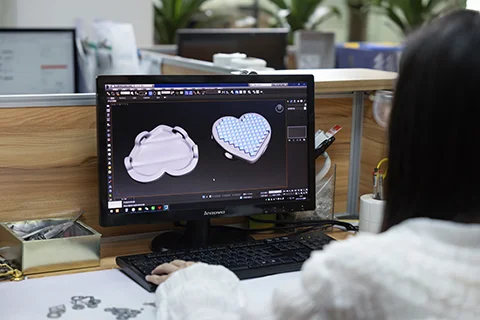
Before a formal order, five things have to be pinned down. The first is the material — copper, stainless steel, zinc alloy or iron — which decides both cost and corrosion resistance. The second is the size: diameter, thickness and shank height, written in full. The third is the logo source file, ideally a vector file, or a bitmap with confirmed clarity. The fourth is the surface finish — polished, matte, aged or vacuum-plated — and the effect differs a great deal. The fifth is the quantity, which decides the tooling cost and the unit price.
The more completely a buyer states these five, the faster the factory schedules the job. Our sampling team can put a brief straight into the line the same day when it lists material, size, logo file and finish; a brief that only says "make it premium" has to go back and forth, dragging a sample that should take three to five days out to two weeks.
These five are not paperwork; they are the points where a project stalls. A missing logo vector file is the most common one, because a low-resolution image looks fine on screen and turns fuzzy on a button. The quantity matters as much as the design, because it decides whether the mould is worth opening at all.
III. How to Judge a Metal Button Prototype
The prototype is the first hard test of a factory. A sample hides nothing — whether the material is genuine, whether the logo is sharp, whether it opens and closes smoothly, whether the tolerance holds, you can see it all at a glance.
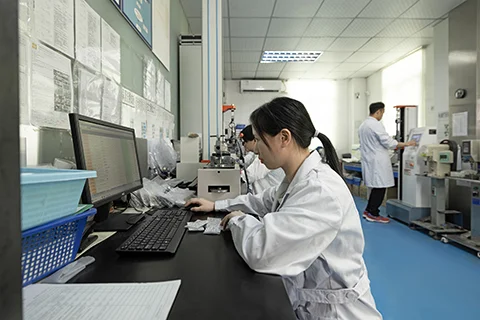
We use around 300 tonnes of copper and 60 tonnes of alloy a month, and every batch of raw material passes a spectrometer, a heavy-metal analyser and a Rockwell hardness tester on arrival, so the sample is made from the same material mass production will use. Judge a prototype on three things: how fast it came, how quickly revisions turn around, and whether the sample and the bulk order share the same standard. A fast sample is half the factory, half the brief, but a sample that mass production cannot repeat is where a factory is truly exposed.
Material substitution is the oldest trick in this trade: show a copper sample, ship a zinc-alloy bulk order. That is why the incoming test on every batch matters, and why a buyer should ask to see the spectrometer and the analyser on the factory floor rather than take a certificate on faith.
IV. Locking Quality Control Before Mass Production
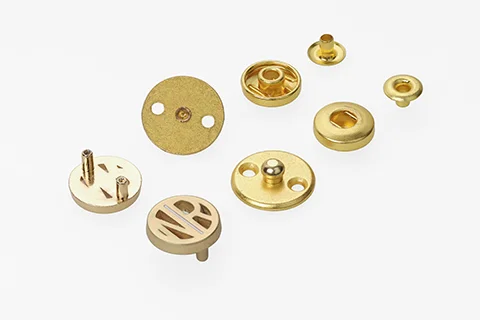
Once the sample is approved and before mass production starts, pin down the quality-control figures one by one rather than discovering problems when the goods arrive. Tolerance is the easiest to overlook: ±0.05 millimetres for standard parts and ±0.025 for functional parts, and holding it steadily matters far more than hitting it once. We hold that precision with a multi-cavity stamping process on nearly 700 machines, keeping accuracy and speed at the same time. Tolerance is easy to overlook because it is invisible on a sample: a jeans button a fraction of a millimetre off will feel too tight or too loose the moment a customer fastens it, so this is the figure to ask for in writing before the presses run.
Tensile strength is the second figure: 35 kilograms or more for a snap fastener, and up to 300 kilograms for special hooks. Lead content is the third — we keep it within 60 ppm, tighter than the 90 ppm limit of OEKO-TEX Class I. Salt spray is the fourth: 1% concentration for 24 hours on standard buttons, and 5% for 50 hours on luxury garment accessories. Ask the factory for numbers on all four, not a spoken "our quality is very good".
V. Delivery and Factory Audits for Metal Buttons
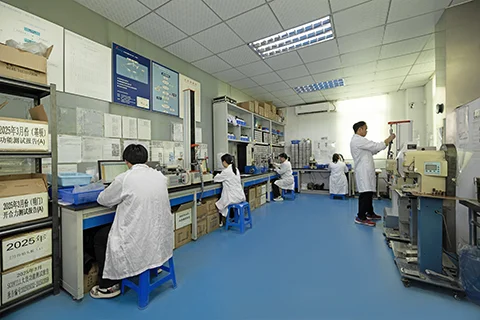
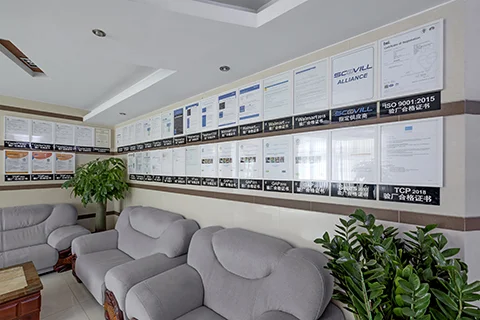
The last gate is delivery and audits. An audit record is the hardest trust signal: which international brands have audited the factory, and how many times, shows how mature its quality-control system is. Songji has passed 72 audits from international brands over the past 10 years, and brands such as Walmart, GAP, VF, LEE and Carter's each stress something different — Walmart on labour and human rights, GAP on process, VF on standards. A factory that holds all of these at once has a system you can rely on.
Test records matter just as much. Our reports are kept for at least five years per batch, so every order can be traced back to its own report. Add more than 150 standardised quality-control processes and a full-batch defect rate below 0.3%, and that is what lets a buyer place the order without worry.
An audit is not a formality. A serious one walks the workshop, checks the testing machines and samples the records, which is why a factory that has passed dozens of them has already been checked harder than most buyers ever could on their own.
VI. A B2B Metal Button Sourcing Checklist
Pull the first five sections into a single list and tick them off before you order. First, sort out whether the factory does OEM or ODM so you do not pick the wrong direction. Second, confirm the five essentials — material, size, logo file, finish and quantity. Third, watch the prototype stage for speed, revision turnaround and whether the sample matches the bulk standard. Fourth, lock down the four quality-control figures — tolerance, tensile strength, lead content and salt spray. Fifth, check that the audit record and test reports line up with the batch.
A factory that answers all five cleanly is basically sound; one that hedges should be dropped. That is the whole of B2B metal button sourcing in one pass.
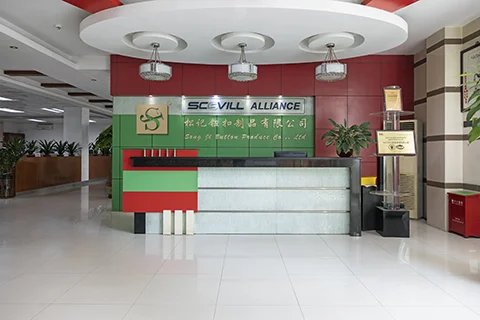
Songji is based in Guanlan, Longhua, Shenzhen, with a 12,000-square-metre factory and nearly 700 machines covering high-speed automatic presses, CNC machining centres and mirror-spark machines. It is a source factory that has focused on metal buttons and garment hardware for 27 years. The product line covers metal buttons, snap fasteners, prong snaps, jeans buttons, tack buttons, shank buttons, rivets, metal badges, hooks and belt buckles, in copper, stainless steel, iron, aluminium and alloy, with more than 10,000 styles and over 100 national patents. The factory holds ISO 9001:2015, OEKO-TEX Standard 100 Class I and GRS certification, has passed 72 audits from international brands over the past 10 years, and keeps its full-batch defect rate below 0.3%. If you are sourcing custom metal buttons for your next season, we would be glad to talk. Want to learn more? Contact us.