For brand buyers in industries such as apparel, luggage, and baby strollers, metal snap fasteners may be small, but they are a key component that determines product quality. A high-quality snap fastener remains as shiny as new even after dozens of washes and stays just as secure after tens of thousands of openings and closings.
In contrast, an ordinary snap fastener may begin to rust after just three or five washes, or become loose and deformed after only a few dozen openings and closings.
What exactly distinguishes a high-quality metal snap fastener from an ordinary one? Faced with the multitude of Chinese metal snap manufacturers on the market, how should buyers select the right product based on specific application scenarios? This article will provide a comprehensive purchasing guide for buyers by examining five key dimensions: product characteristics, application suitability, specification selection, material and manufacturing processes, and quality control systems.
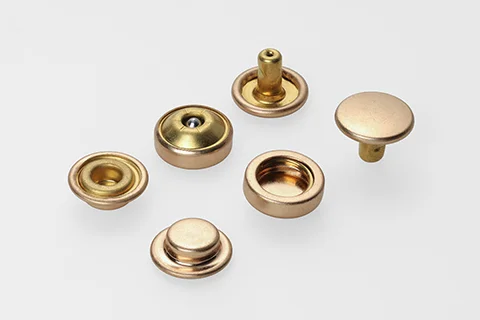
I. The Difference Between High-Quality Metal Snap Fasteners and Ordinary Ones
The distinction between high-quality metal snap fasteners and ordinary ones primarily lies in three aspects: materials, manufacturing processes, and quality control. These differences ultimately manifest as significant disparities in durability, safety, and consistency.
High-quality snap fasteners typically use high-purity, eco-friendly copper with a copper content of ≥99.5% or premium base materials such as 304 stainless steel, with spectral analysis ensuring compliance with composition standards. In contrast, ordinary snap fasteners often use recycled copper or low-quality zinc alloys, which have high impurity levels and are prone to rusting and breaking.
Regarding surface treatment, high-quality snap fasteners employ a cyanide-free electroplating process, resulting in a uniform and durable coating that withstands 2,000 friction tests without exposing the base material and 72-hour salt spray tests without rusting. In contrast, ordinary snap fasteners have thin and uneven coatings that expose the base material after just 500 friction tests and develop rust spots within 24 hours of salt spray testing.
Dimensional accuracy is another key distinction. High-quality snap fasteners maintain tolerances within ±0.05 mm, with critical areas as tight as ±0.025 mm, ensuring consistent installation and smooth operation. Ordinary snap fasteners exhibit significant tolerance fluctuations, with inconsistent dimensions even within the same batch, which can easily lead to installation failures. In terms of clamping force, high-quality snap fasteners are precisely calibrated to maintain consistent opening and closing performance even after tens of thousands of cycles. Ordinary snap fasteners exhibit significant variations in clamping force; if too loose, they easily come undone, while if too tight, they are difficult to operate, and their clamping force diminishes rapidly.
The differences in safety standards are even more pronounced. High-quality metal snap fasteners are certified to OEKO-TEX® Standard 100 Class I, with lead content ≤60 ppm, and feature rounded edges free of burrs. Ordinary snap fasteners may exceed heavy metal content limits, and their rough edges can even scratch fabric or skin.
Take the snap fasteners customized by Songji Buttons for BMW’s child safety seats as an example: they pass a 300-kilogram tensile strength test and a 72-hour salt spray test, ensuring they remain secure and reliable even under extreme conditions. Meanwhile, the snap fasteners customized for the infant and children’s brand Carter’s have lead content controlled below 60 ppm, with edges rounded and polished, fully complying with European and American safety standards for children’s products.
II. Requirements for Snap Fasteners in Different Application Scenarios
Metal snap fasteners have a wide range of applications, from apparel and luggage to strollers and outdoor gear, with significant differences in functional requirements across different products. When purchasing, select the style based on the actual usage scenario to avoid mismatches between the chosen model and the intended application.
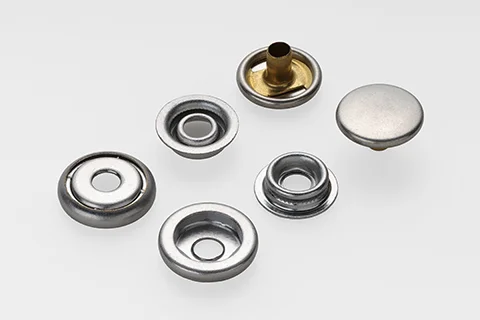
In the apparel sector, lightweight fabrics such as silk, chiffon, and shirting require small, thin, flat snap fasteners with a diameter of 8–10 mm and a thickness of 1–1.5 mm. These feature a simple structure and are lightweight to prevent damaging the fabric. Songji’s four-hole buttons, designed for high-end women’s custom clothing under the Ying’er Fashion Group, utilize CNC machining centers to precisely adjust the angle and length of the button shanks. This ensures consistent fastening strength while preventing issues such as buttons coming loose.
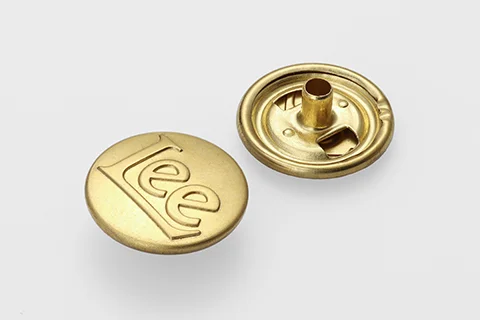
For heavy fabrics such as denim, wool, and overcoats, reinforced four-hole buttons are required, with a diameter of 12–15 mm and a thickness of 2–3 mm. These feature extended shanks and reinforced construction to ensure a secure, non-loosening fit after installation. When serving denim brands such as LEE and DIESEL, Songji employs the reinforced design combined with precise claw angles, enabling the four-hole buttons to achieve a tensile strength of over 150N on thick denim fabrics—40% higher than standard models.
The infant and children’s product sector imposes the highest safety requirements for snap fasteners, necessitating the priority selection of safety-rated models. These products require rounded-corner designs with no sharp edges, moderate fastening force to prevent accidental opening or detachment by children, and materials that strictly comply with children’s product safety standards. The four-way snaps customized by Songji for infant and children’s brands such as Carter’s and Combi have all passed OEKO-TEX® Standard 100 Class I certification, with lead content ≤60 ppm and nickel release levels compliant with EU standards. The edges are rounded and polished to ensure safety for infants during use.
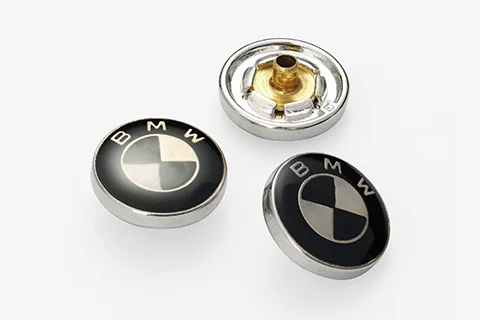
The requirements for snap fasteners in the stroller and car seat sectors are even more stringent. A high-end stroller may feature anywhere from a dozen to over sixty metal snap fasteners, used in critical areas such as seatbelt connections, seat adjustments, and canopy fastenings. These products require reinforced or waterproof snap fasteners; the reinforced version uses thickened base materials for high tensile strength, while the waterproof version features sealed edges to withstand humid environments. The snap fasteners customized by Songji for brands such as NUNA, JOIE, and BMW child safety seats have passed 35-kilogram tensile strength tests and 72-hour salt spray tests, meeting the dual demands of safety and durability in the children’s stroller sector.
In the luggage and outdoor gear sectors, snap fasteners must withstand frequent opening and closing as well as extreme weather conditions. Therefore, stainless steel snap fasteners are the ideal choice for the outdoor industry. The snap fasteners Songji customizes for CARHARTT outdoor workwear are made of high-purity 304 stainless steel and have passed 72-hour salt spray tests and 50 cycles of enzyme washing tests, ensuring the fasteners remain secure and durable during actual use.
III. Key Considerations for Selecting Snap Fastener Specifications
The specifications of metal snap fasteners must precisely match the thickness of the product fabric and the intended use; any mismatch in parameters will directly result in installation failure or malfunction.
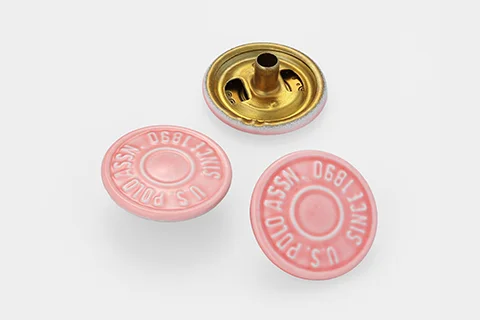
For example, clothing generally uses small snap fasteners (8–12 mm), while jackets and luggage use large snap fasteners (15–20 mm). Thickness should be selected based on fabric thickness: choose 1–2 mm thin styles for lightweight fabrics and 2–3 mm thick styles for heavy fabrics. The shank length should be slightly longer than the fabric thickness—typically 0.5–1 mm longer—to ensure secure fastening after installation while preventing the fabric from bulging due to excessive length.
Songji Buttons boasts a product library of over 10,000 styles, covering flat, thickened, and embossed designs, among others. With a comprehensive range of specifications and support for customization, we can tailor button solutions to meet diverse customer needs. Shenzhen Songji Buttons’ proprietary “one-mold, multiple-piece” manufacturing process increases production capacity by 6–10 times while maintaining product dimensional tolerances within ±0.05 mm, ensuring high consistency in large-scale button production.
IV. How Materials and Manufacturing Processes Determine the Quality of Metal Four-Hole Buttons
The material of metal four-hole buttons directly determines their durability and safety. High-quality manufacturers establish strict standards during the raw material screening process.
For example, Songji Buttons’ raw material acceptance criteria require eco-friendly copper with a copper content of no less than 99.5%, and total lead content is consistently controlled below 60 ppm using heavy metal detectors—a value far exceeding the standard limits set by the EU REACH regulation.
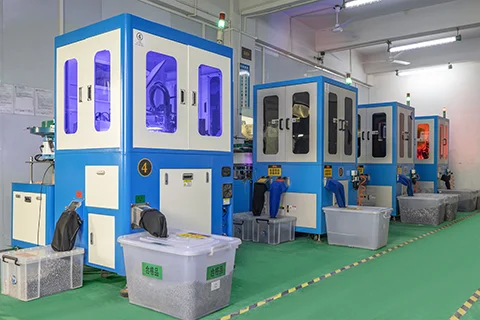
In terms of manufacturing processes, advanced production equipment and precision craftsmanship form the foundation of quality assurance. Songji possesses nearly 700 units of fully automatic high-speed punch presses, CNC machining centers, and other equipment. Its proprietary “one-die-multi-piece” process utilizes a closed-loop pressure feedback system to control general dimensional tolerances within ±0.05 mm and narrow critical functional fit tolerances to ±0.025 mm.

V. The Importance of a Comprehensive Quality Control System
A robust quality control system is key to ensuring the consistent quality of metal snap fasteners. Professional manufacturers establish a full-chain quality control system covering raw materials, production processes, and finished products.
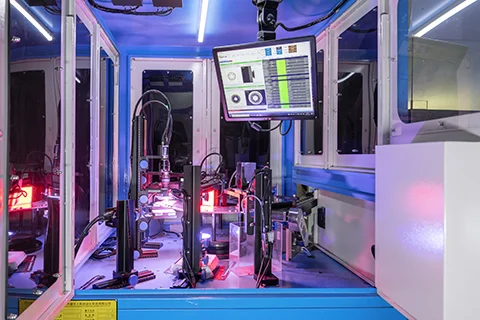
Songji Buttons has established over 30 standardized inspection checkpoints throughout the entire production process. In the raw material stage, spectral analyzers are used to screen for chemical composition; during process control, hourly inspections are conducted for operations such as stamping, polishing, and electroplating, with dynamic monitoring of 15 common defect types, including deformation of the face plate, burrs on the button head, and eccentricity of the spring cup; In the final product verification stage, electric button-sewing machines simulate actual assembly scenarios prior to shipment to eliminate products with insufficient fastening strength.
All inspection reports are categorized and retained, including wash test reports, salt spray test reports, and tensile strength test reports. These records are kept for at least five years to ensure that any quality issues can be quickly identified and traced. Thanks to this quality control system, Songji has obtained British BS1:ISO9001:2015 quality management system certification, as well as Swiss OEKO-TEX® Standard 100 Class I certification and Global Recycling Standard (GRS) certification—the latter of which is held by only 10% to 20% of companies in the button industry. Over the past decade, the company has successfully passed 72 on-site audits conducted by eight international brands, including GAP, Walmart, LEE, and Carter’s.
Conclusion
Purchasing metal four-hole buttons is, at its core, a choice between a high-quality product and an ordinary one. From the minimalist requirements of everyday apparel to the durability demands of outdoor gear, from the safety standards of infant and children’s products to the premium texture of luxury brands, each product category dictates distinct selection criteria for four-hole metal buttons. Only by choosing a Chinese metal button supplier capable of providing precisely tailored solutions for specific applications can you ensure your products meet expectations in terms of durability, safety, and consistent quality.
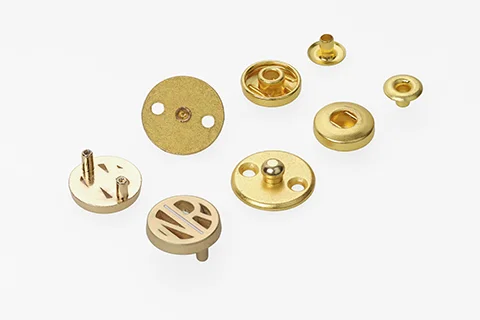
With nearly two decades of industry expertise, Songji Buttons has provided custom metal snap fastener solutions to over 500 global brands, including GAP, LEE, CARHARTT, NUNA, and BMW child safety seats. If you are looking for a reliable Chinese metal button manufacturer, contact us today!