On a suit, metal shank buttons are among the few hardware pieces where the craftsmanship is visible — the way the shank sews into fine worsted wool, whether the thread survives repeated fastening and unfastening, and whether the button stands at the right height for the fabric thickness, all read instantly to the hand. For premium tailored apparel, the technical threshold of a metal shank button is not in the stamping, but in the shank construction and the sewing durability. Songji has made metal buttons for 27 years, and its sewn-button and shank-button product lines serve exactly the suit and coat categories that need thread-fastened metal buttons.
I. Shank Construction Determines Sewing Durability in Metal Buttons
The fundamental difference between a shank button and a snap fastener or tack button is that a shank button is held to the fabric by thread, not by mechanical riveting. The button face carries a raised shank on the back. The thread passes beneath the shank and wraps around it several times to sew the button onto the fabric. The height of the shank decides how far the button sits off the fabric — too low and the button clings flat against the cloth, tugging the fabric every time it is fastened; too high and the button looks clumsy, breaking the clean line of a suit front.
Shank formation comes in two routes, and this is the core process distinction. Integral formation stamps or casts the shank and the face as one piece, the strongest option, suited to high-stress placket positions. Separate attachment rivets or solders a pre-made shank onto the back of the face, cheaper but leaving the joint as a detachment risk point — repeated fastening plus dry cleaning will fatigue the joint until the shank shears off at the root. For premium suit buttons, that joint has to pass a pull test.
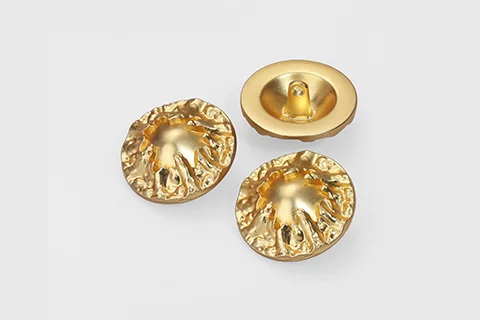
II. Material and Surface Finishing for Metal Shank Buttons
The material of a suit shank button decides its feel and quality. Premium suits mostly use copper alloy, with H65 and H68 brass as the mainstream — copper has a warm texture and good ductility, and after plating it shows a fine metallic lustre that never looks cheap against worsted wool.
Surface finishing is the other key. Nickel plating gives a muted silver tone for dark business suits. Gold and imitation gold plating give a warm tone for more classic tailored suits. Antique finishing uses oxidation to build a vintage texture for retro-style suit jackets. On this front, Songji holds heavy metal content within 40PPM, far stricter than regulatory limits, and the environmental safety of its materials and plating meets OEKO-TEX Standard 100 Class I certification.
When Songji makes metal buttons for high-end womenswear brands like PORTS, the route is a copper alloy base with fine electroplating, so the button texture echoes the weave of wool-blend fabric. The requirement these premium apparel brands place on hardware is the same logic that applies to suit shank buttons — the quality has to match the fabric, and the craftsmanship has to hold up under close inspection.
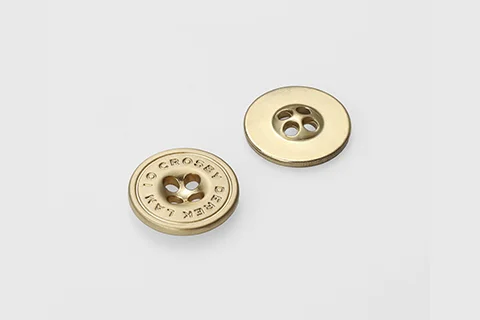
III. Customisation Capability Is the Core Barrier in Songji Shank Buttons
The customisation threshold for shank buttons is far higher than for standard fasteners. Snap fasteners and tack buttons have mature standard tooling that can be applied directly. A shank button's shank height, face shape and surface finish all have to follow the suit design, so no two custom shank buttons are ever quite the same.
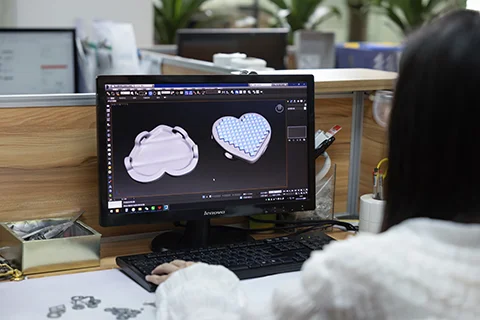
Songji's customisation capability shows in a full-loop chain from design to production. A client provides a drawing or a physical sample, and Songji's tooling team completes die design, electrode machining, die trial and first-sample sign-off inside the factory campus, without parcelling work out to external workshops. Prototyping compresses to 3 to 5 working days, and the full path from receiving a drawing to production can finish within a month. Songji currently holds more than 100 national patents, launches hundreds of new designs each month, and spans over 10,000 styles, with customisation covering everything from shank buttons to snap fasteners, tack buttons, rivets and alloy plates.
PORTS is a high-end womenswear brand that Songji has supplied with custom metal buttons on a long-term basis. Burberry is a luxury brand for which Songji has made bag buckles — the hardware requirement of a luxury brand is the same standard that applies to premium suit shank buttons: material, surface finish and edge detail all have to hold up under a magnifying glass.
IV. What Premium Apparel Brands Look for When Sourcing Suit Shank Buttons
When premium apparel brands audit a factory, they look at shank buttons from a completely different angle than ordinary clothing. They do not look at capacity or price. They look at three things — customisation response speed, batch consistency and whether test data can be traced.
Customisation response speed decides how far the partnership can go. A premium suit brand launches dozens of new styles each quarter, and each style may involve new shank design and surface finishing. If the factory's sampling speed cannot keep up, the whole development rhythm stalls. Songji's 3-to-5-working-day prototyping cycle, plus hundreds of new designs per month, matches the development pace of premium apparel brands.
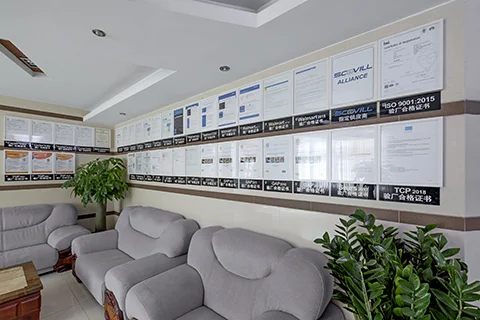
Batch consistency is the other hard gate. Shank joint strength, shank height and surface colour must stay consistent with the confirmed sample on every batch. Songji holds its long-term defect rate below 0.3% and dimensional tolerance at ±0.05mm. Over the past 10 years, Songji has passed 72 international brand audits, with quality management and traceable test data as mandatory items every time. Inspection records are kept for at least 5 years, and any batch of shank buttons can be traced back to its raw material and processing steps.
V. A Sourcing Checklist for Suit Shank Buttons
When sourcing metal shank buttons for suits, run through these 5 items before placing an order.
-
Is the shank integrally formed or separately attached? Is there pull test data on the joint, and will it shear off at the root after a few wears?
-
Does the shank height match the suit fabric thickness? Will it cling flat or look clumsy?
-
How long is the custom prototyping cycle? How many days from drawing to first sample, and how many revision rounds will they accommodate?
-
Do the material and surface finish match the suit's design? Is there corresponding test data?
-
How many years back can test data be traced by batch? If a quality problem arises, can it be traced to the raw material and processing steps?
Run through these 5 items and the gap between a metal button factory that treats shank buttons as high-end custom work and a bulk stamping shop becomes clear.
Songji Buttons was founded in 1999, has focused on metal buttons for 27 years, operates a 12,000 m² production base in Shenzhen with close to 700 machines, holds OEKO-TEX Standard 100 Class I and ISO 9001 certifications, has passed 72 international brand audits over the past 10 years, and supplies custom metal buttons to brands including LEE, GAP, Carter's, VF and Walmart. If you need metal shank buttons for suits, we would love to hear from you. Get in touch today.