The colour, lustre and durability of a metal button come almost entirely from its surface plating. Same copper alloy button, right electroplating process — the garment still looks near-new after 30 washes. Wrong process — the base metal shows through on the first wash. Plenty of buyers only read the material column on a quotation, when the real difference lies in the plating. Here is the full path of a custom metal button, from bare metal to finished plating layer, broken down step by step.
I. The Electroplating Finishes Most Commonly Used on Metal Buttons
"Electroplating" is not one action but a family of processes. The finishes most common on metal buttons are nickel plating, brass and imitation gold plating, antique brass, chrome plating, PVD vacuum ion plating, plus electrophoretic coating and spray coating.
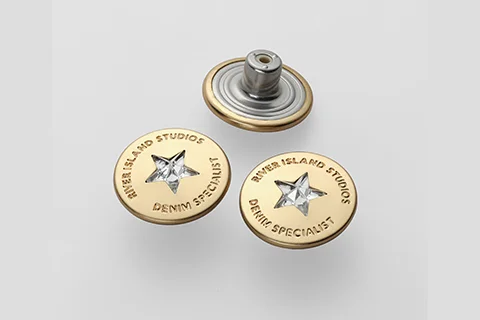
Nickel plating is the most basic silver finish — corrosion-resistant, moderately priced, and often the under-layer in a multi-layer plating stack. Brass and imitation gold give a warm gold tone, the classic base colour of vintage denim buttons. Antique brass is the heart of the vintage look — an oxidised layer is built up on the copper alloy, then partially polished away to reveal the copper underneath and create a natural aged character. Chrome plating is a mirror-bright silver, decorative but costlier than nickel. PVD vacuum ion plating delivers the strongest adhesion of the group, with abrasion and salt spray performance well beyond traditional electroplating, suited to outdoor workwear buttons and rivets that demand heavy durability. Electrophoretic and spray coating serve brand-specific colours — when the logo colour must align tightly with a brand's visual identity, traditional plating cannot hit an exact shade, while electrophoretic and spray coating can sample directly against a colour card.
For denim specifically, vintage-leaning brands tend to take the antique brass route while clean-line collections lean nickel. The two routes differ in plating parameters, cost and durability targets. The choice follows brand tone and usage scenario, not a question of which is superior.
II. Surface Pretreatment Determines Whether Metal Button Plating Stays On
Plating does not happen by dropping a button into a tank. If the bare metal surface carries oil or oxide scale, the plating will not bond — no matter how thick the layer is later, it will blister and peel.
Pretreatment runs three steps: degreasing, pickling and activation. Degreasing removes oil left by stamping. Pickling strips the oxide layer off the metal surface. Activation brings the surface to the reactive state plating requires. Whether these three steps are done and done well directly decides plating adhesion. A metal button with inadequate pretreatment shows no problem at the factory gate, then the plating starts lifting from the edges after some use.
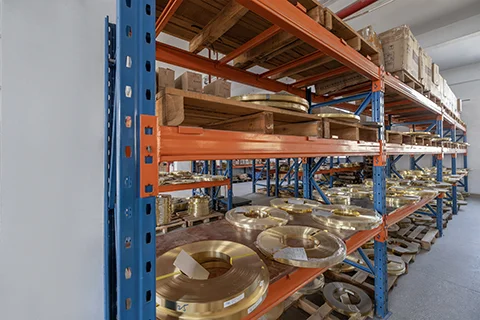
For a buyer, pretreatment is an invisible step, but it sets the ceiling for every step that follows. This is why evaluating a factory cannot stop at its plating line equipment list — you have to check whether it runs a screening standard that actually holds incoming material and substrate to account.
III. What Matters Inside the Electroplating Tank for Snap Fasteners, Tack Buttons and Rivets
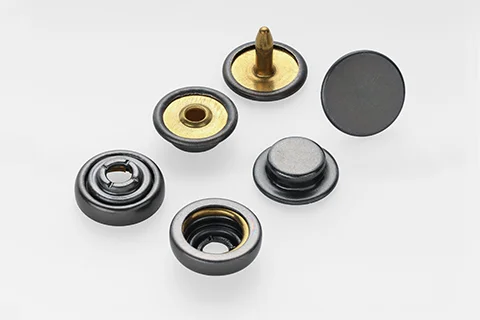
The core variables in the plating tank are current density, temperature and time. Together they decide plating thickness and uniformity. When current density is uneven, thickness varies across the recesses and raised areas of the button. The faces of snap fasteners, the raised logos of tack buttons and the shanks of rivets are all positions prone to uneven plating — raised edges can come out thinner and wear through first.
Premium metal buttons generally use multi-layer plating, with each layer doing a different job. The base layer handles corrosion resistance, the middle layer boosts adhesion, and the top layer sets the final colour and lustre. Single-layer plating saves cost but sacrifices both corrosion and abrasion resistance. Plating thickness is measured with X-ray fluorescence gauges, not by a veteran's eye.
Custom plating schemes are designed around the depth of a logo, the density of its pattern and the intended usage scenario — not applied from an off-the-shelf plating line. The more detail a button carries, the more the tunability of its plating parameters matters.
IV. Post-Treatment and Sealing Decide How Long Denim Button Plating Lasts
After plating comes a step that is easy to overlook — post-treatment. The plated surface has microscopic pores invisible to the eye. Sweat and the corrosive agents in detergent seep in through those pores and corrode from the inside out. Post-treatment seals them shut.
Passivation and sealing are the two main post-treatment measures. Whether this step is done properly decides how long a denim button or tack button holds up in humid environments and high-frequency wash cycles — the tighter the sealing, the better the logo and colour retention. Songji handles this detail by sealing the micro-pores on the plated surface to block corrosive media from penetrating, which extends service life more effectively than simply chasing plating thickness. What actually separates factories in this industry often turns out to be this seldom-mentioned step.
V. How Metal Button Plating Is Tested Against Industry Standards
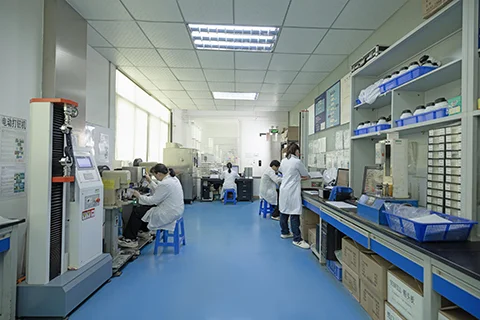
Whether a metal button's plating holds up comes down to test data. The core industry test is the salt spray test — ASTM B117 neutral salt spray, using a 5% sodium chloride solution at a constant 35°C to simulate a corrosive environment. Twenty-four hours is the indoor baseline, 48 hours is standard garment grade, and 96 hours is outerwear and sportswear grade.
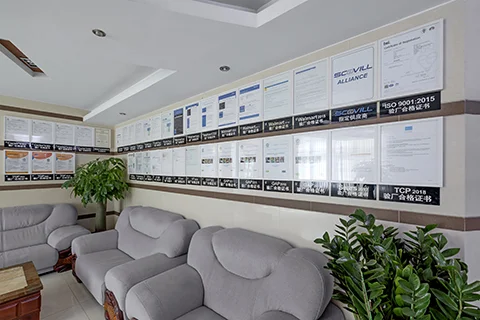
Songji runs standard metal buttons to a 72-hour neutral salt spray benchmark, 50% longer than the 48-hour industry norm, and high-end custom pieces for outdoor workwear also undergo CASS copper-accelerated acetic acid salt spray testing. Beyond salt spray, plating is tested for adhesion — scratch and bend tests check whether it lifts or peels; thickness — confirming the layer meets design value; and colour fastness — confirming the colour does not fade after washing. Chemical compliance is the other hard line: nickel release from the plating must meet REACH limits, and Songji's products satisfy OEKO-TEX Standard 100 Class I certification with a self-imposed heavy metal limit of no more than 40PPM.
VI. Eco-Friendly Metal Button Electroplating Is Now a Hard Requirement
The biggest environmental problem in traditional electroplating is cyanide — cyanide-based plating produces wastewater and exhaust that are costly and polluting to treat. The industry's direction in recent years has been a shift to cyanide-free plating, replacing cyanide with more environmentally friendly bath formulations.
For mid-to-high-end brands, environmental compliance at the metal button plating stage is not a bonus but a barrier to entry — a brand's ESG review drills straight down to the plating process. Songji uses cyanide-free plating with a wastewater treatment system to control discharge, and holds HIGG FEM environmental performance assessment and GRS certification at the environmental credential level.

Songji Buttons was founded in 1999, has focused on metal buttons for 27 years, operates a 12,000 m² production base in Shenzhen with close to 700 machines, holds OEKO-TEX Standard 100 Class I and ISO 9001 certifications, has passed 72 international brand audits over the past 10 years, and supplies custom metal buttons to brands including LEE, GAP and Carter's. If you need custom electroplated metal buttons, we would love to hear from you. Get in touch today.