Snap fasteners and jeans buttons sit on the same line of many sourcing spreadsheets — both filed under "metal buttons." But their structures work differently, their plating takes stress differently, and they fail in completely different ways. Getting the choice wrong does not show up at the sampling stage. A sample run produces a few dozen pieces, and a structural mismatch cannot surface at that volume. The problems only explode once bulk production hits the sewing line and the garments reach the consumer — fabric tearing, plating peeling, fastening failure. Understanding these two fastener types at the structural level is not about learning button taxonomy. It is about plugging quality and complaint risks before they open.
I. How Snap Fastener and Jeans Button Structures Are Fundamentally Different
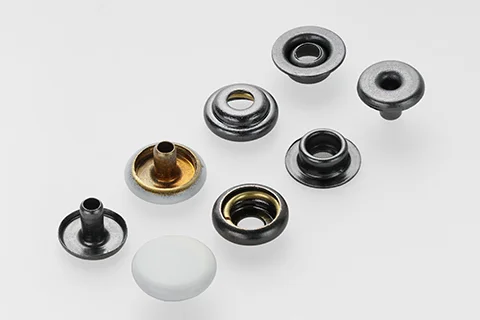
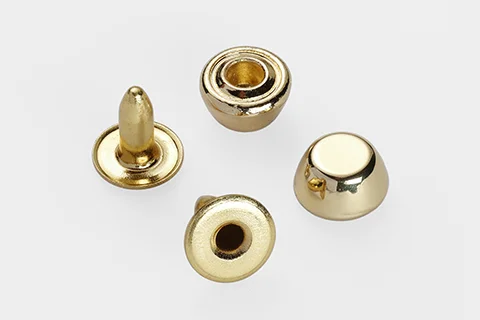
A snap fastener is a four-part assembly — cap, socket, stud and post, each with a distinct function. The socket contains a spring ring. The stud snaps into this ring and is held by spring tension. Applying reverse force overcomes that tension and the snap opens. This mechanism makes snap fasteners suitable for positions that need repeated opening and closing: the crotch of a baby romper, the pocket flap of workwear, the placket of a jacket.
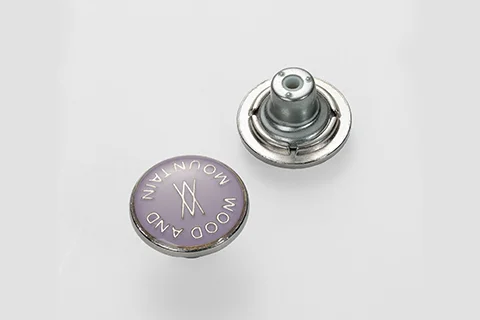
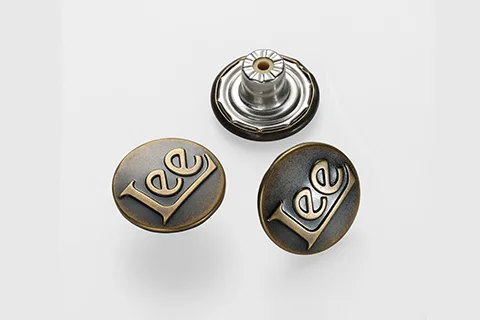
A jeans button — commonly called a tack button in the trade — is a two-part assembly: a button face and a tack. The tack is driven through the fabric from the reverse side. The button face is pressed onto the tack shank from the front, and mechanical pressure expands the shank to create a riveted, permanent bond. Once fastened, the button stays fixed. It will not release unless the assembly is physically destroyed. This makes tack buttons suited to positions that do not need frequent unfastening: the waistband of jeans, stress points on workwear, fixed closures on outerwear.
The direction of force is also completely different across the two types. A snap fastener takes force perpendicular to the fabric plane — pulling it open works against spring tension, and the key test measures how much fastening force is retained after repeated cycling. A tack button takes force parallel to the fabric plane — tugging applies shear force through the textile, and the key test measures how securely the tack grips the fabric.
II. Which Metal Button Plating Finish Survives Which Environment
Whether on a snap fastener or a tack button, the plating is the first line of defence for durability. Electroplating, spray coating, electrophoretic coating and PVD vacuum ion plating — these processes differ dramatically in abrasion resistance, corrosion resistance and tactile quality.
Electroplated brass is the most common finish choice for vintage-style denim, offering a natural copper tone and a warm touch. But electroplated brass performs worse than nickel plating and PVD in salt spray testing. In humid climates or high wash-frequency scenarios it can darken through oxidation or experience plating delamination. PVD vacuum ion plating delivers the strongest adhesion, with salt spray and abrasion performance well beyond traditional electroplating, though at a higher cost and process threshold. Spray coating and electrophoretic finishes are often used for custom colour matching, with the trade-off that prolonged friction can produce localised wear.
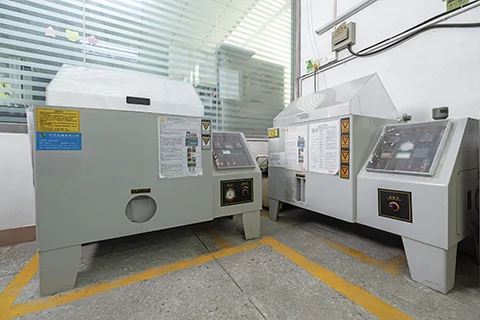
The industry standard salt spray test is ASTM B117 neutral salt spray — a 5% sodium chloride solution at a constant 35°C. Twenty-four hours represents basic indoor-use grade. Forty-eight hours is standard garment grade. Ninety-six hours is high-grade for outerwear and sportswear. Songji runs standard metal buttons to a 72-hour neutral salt spray benchmark, 50% longer than the 48-hour industry norm. Custom high-end pieces for outdoor workwear and extreme-use scenarios undergo an additional copper-accelerated acetic acid salt spray test — copper chloride added to the salt solution, chamber temperature raised to 50°C, corrosion accelerated to roughly 8 times the standard rate.
Choosing a plating is not choosing a colour. It is deciding whether a button can survive sweat, detergent and friction across the full service life of the garment.
III. Pull Strength Standards Are Not the Same Across Button Types
The most common mistake buyers make when reviewing tensile reports is applying a snap fastener standard to a tack button, or the reverse.
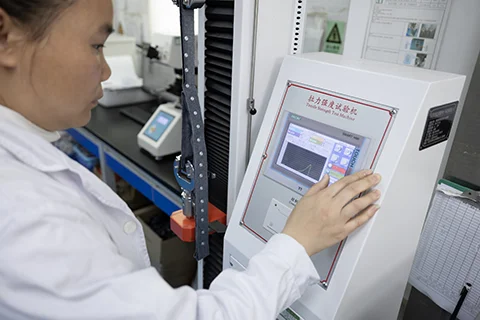
Under industry standards, adult snap fasteners reference ASTM D7142 with a baseline of 50N. Baby clothing under EN 71-1 requires 70N or above. The test measures pull-off force perpendicular to the fabric, simulating the action of unsnapping.
Tack buttons do not have a unified international pull standard. Requirements vary across brand specifications but generally start at 90N or above, with some leading brands setting their own thresholds at 120N. The test measures the security of the tack's grip on the fabric, not an opening force.
Songji snap fasteners hold above 35kg of pull force, approximately 343N. Special hook fasteners withstand over 300kg. Put those numbers back into the industry context — 343N is roughly 6.8 times the ASTM D7142 requirement, leaving a generous decay margin even after repeated cycling and wash simulation. And "durability" means completely different things across button types: for a snap fastener it means spring life and fastening-force retention; for a tack button it means tack grip security and plating wear resistance.
IV. Matching the Right Metal Button Type to the Right Garment
Jeans waistbands and fly closures call for tack buttons and rivets. These positions do not need frequent unfastening. What they need is a secure bond between the tack and the fabric that withstands the lateral pull from a belt and daily sitting and standing.
Baby romper crotch and shoulder positions call for snap fasteners. Infants need frequent changes, so repeated opening and closing is a functional requirement. EN 71-1 and 16 CFR 1500.51 small parts pull testing are mandatory standards, and both fastening force and chemical safety must pass simultaneously. OEKO-TEX Standard 100 Class I certification — corresponding to the infant-grade level — is the entry threshold for baby garment snap fasteners.
Jackets and coats depend on the design. A single-breasted coat pairs with tack buttons. A double-breasted windbreaker might use snap fasteners. But outerwear faces the external environment, so the plating needs to clear a salt spray grade at least one level above underwear and T-shirts — 48 hours NSS as a floor.
Workwear and outdoor gear call for heavy-duty snap fasteners. Workwear is the most demanding category for buttons across all apparel: frequent cycling plus harsh environments plus aggressive industrial washing. Salt spray requirements reach 72 or even 96 hours, and pull strength must show no meaningful drop after repeated cycling. When Songji developed buttons for GAP, the chemical line had to clear OEKO-TEX Class I while the physical line cleared three gates — the brand's own pull strength, cycle-life and salt spray standards. Both lines had to run green before shipment.
V. What Experienced Buyers Check Across Both Metal Button Categories
Snap fasteners and tack buttons follow different technical paths, but the criteria for evaluating whether a metal button factory is worth a long-term partnership are shared.
Process consistency — can the defect rate be held below 0.3%, can dimensional tolerance stay within ±0.05mm? Songji has passed 72 international brand audits over the past 10 years, with quality management and document traceability as mandatory items every time.
Plating testing — salt spray data is static. Adhesion testing and post-friction surface changes are dynamic. Can every shipment produce its own plating test data rather than one submission covering a full year?
Pull strength data — different button types reference different standards. When a supplier quotes a pull figure, can they specify which button type and which test standard it was measured against?
Chemical compliance — OEKO-TEX certificate class and expiry, self-imposed heavy metal limits with measured data, batch-level traceability back to raw material and electroplating workshop.
Songji Buttons was founded in 1999, has focused on metal buttons for 27 years, holds OEKO-TEX Standard 100 Class I certification, achieves snap fastener pull strength above 35kg and special hook fastener strength above 300kg, has passed 72 international brand audits over the past 10 years, and supplies custom metal buttons to brands including GAP, LEE and Carter's. If you are selecting the right metal button for your garment, we would love to hear from you. Get in touch today.