When a premium brand visits Songji for a factory audit, they rarely head into the meeting room first. They walk straight to the stamping line. After 40 minutes watching the press, they pick up a freshly punched snap fastener, turn it between their fingers, and ask the question that is not on the agenda — "Same die, a million pieces versus ten thousand — how much dimensional drift?"
That question is the signal. The quotation has already gone back and forth across three email rounds. The dimension sheets have been sent, the certificates forwarded. Everything that can be discussed on paper has been discussed. The brand team is there to confirm one thing in a single day: whether this factory's quality management is the kind a premium brand can trust over the long run.
The four dimensions below are the areas premium brands repeatedly check during an audit at Songji. Songji's own clients — LEE, GAP, Carter's — focus on these same four directions every time. Any premium brand evaluating a metal button manufacturer in China can run this framework as a checklist.
I. What a Premium Brand Looks for First in a Metal Button Factory
It is not how clean the workshop is. It is the degree of standardisation behind the tooling.
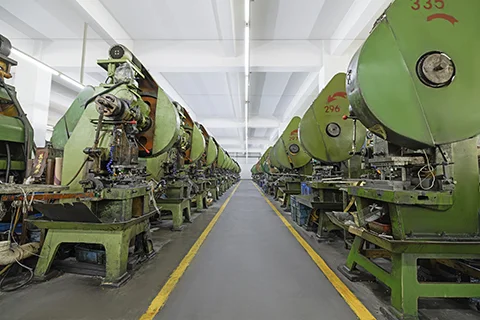
Songji uses a single-die multi-cavity stamping process. One die produces 6 snap fastener pairs in a single stroke. One die produces 11 prong rings in a single stroke. Same die, same run, same batch — dimensions and geometry are inherently consistent. Among close to 700 pieces of equipment, the fully automated high-speed presses and automatic packaging lines are not there to replace labour. At this level of manufacturing, automation does not save money. It eliminates the batch-to-batch variation that manual handling introduces.
The long-term defect rate is held below 0.3%. Dimensional tolerance is kept to ±0.05mm for general requirements and ±0.025mm for functional requirements. When a brand asks "how much drift between a million pieces and ten thousand," Songji's answer is: within a single die service interval, consecutive batches stay within the process standard with no meaningful deviation. Cross-batch variation records are available, with test data per batch archived for 5 years.
By the time a premium brand asks that question, they have usually already encountered suppliers who can quote a price but cannot produce production-run data. For a premium brand, consistency does not mean "the sample looked good." It means "not one of a million pieces fails." Songji has passed 72 international brand audits over the past 10 years, conducted by compliance teams from GAP, Walmart and Carter's. Those teams come to the factory to do the same thing — trace upstream and downstream, check whether the production line is stable, and verify that batch-level data has no gaps.
II. Brand Audit Records Say More About a Metal Button Manufacturer Than Any Certificate
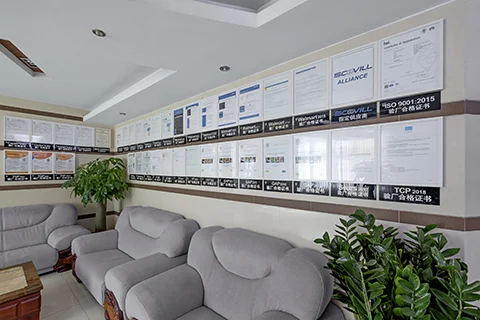
Certificates are static. Audits are live. ISO 9001 says you have a quality system. A brand team walking the floor can tell in minutes whether that system is switched on or off today.
Among Songji's 72 audits over the past 10 years, some brands stayed for 4 days — tracing from raw material receipt records to finished-goods shipping labels, from electroplating workshop certifications to wastewater treatment permits. The brands that audited and kept reordering — GAP, Walmart, Carter's — each have reorder histories that are not short. When a premium brand evaluates a metal button factory, asking "have you been audited" is not enough. The questions are: audited by whom, how many times, and did they keep reordering afterwards. The answers to those three questions carry more weight than any certificate. Throughout Songji's company history, quality management and document traceability have been mandatory items in every single audit.
III. R&D Depth on Custom Metal Buttons Determines How Far the Partnership Goes
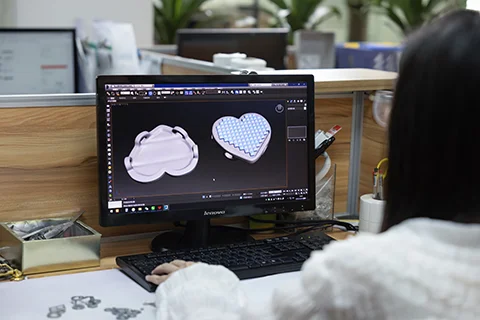
Premium brands rarely use off-the-shelf buttons. Logo customisation, pattern development, surface finish selection, colour matching — every step is a development stage.
When Songji developed metal buttons for LEE, the chain ran from the visual signature of symmetrical patterning through the tactile refinement of rounded edges to the precision tooling that controlled the raised logo height. The entire pipeline, from design drawing to production launch, closed within a single factory site. For GAP, the route was different: zinc alloy material matched to GAP's broad garment line, with multiple surface finishing options presented at the prototyping stage. Songji currently holds more than 100 national patents, launches hundreds of new designs each month, spans over 10,000 styles and can compress prototyping to 3 to 5 working days.
A premium brand's development cycle moves slower than fast fashion, but its margin for error is far narrower. One delay can scrap an entire season's launch plan. A factory's customisation response speed directly determines whether the relationship moves from "let's try one order" to long-term partnership.
IV. Chemical Compliance Is a Baseline in a Premium Supply Chain, Not a Bonus
By the time a brand team reaches the audit stage, they tend not to spend much time leafing through certificates. OEKO-TEX Standard 100 and REACH requirements have already been confirmed before the visit. What they are there to verify is the depth of the compliance system: what the self-imposed limits are, and whether every batch can be traced back to its electroplating workshop.
Songji's answer is unambiguous. The self-imposed heavy metal limit is no more than 40PPM, while OEKO-TEX Class I sets the lead limit at 45PPM — Songji's standard is tighter still than the benchmark for infant-grade products. Every shipment carries its own test data, archived for 5 years, and any batch can be traced back to its raw material lot and electroplating workshop. REACH compliance is met. GRS certification covers brands with recycled-material requirements. HIGG FEM environmental performance assessment and GAP-TQP supplier quality certification are two credentials premium brands weigh heavily during ESG reviews.
For a premium brand, chemical compliance is not a bargaining chip. It is the entry door. If it does not pass, the factory never reaches the audit stage. What makes a brand decide "this can be a long-term partnership" after the audit is the depth of the compliance system — whether you can trace by batch, and whether you can pull the data from several years ago.
There is no dramatic pivot in this evaluation process. Every question the brand asks, Songji answers at the data level, not the attitude level. The evaluation logic premium brands apply to metal button factories comes down to four directions: process consistency judged by data, audit records judged by years and reorder rates, R&D depth judged by live cases, and compliance judged by depth of traceability.
Songji Buttons was founded in 1999, has focused on metal buttons for 27 years, operates a 12,000 m² production base in Shenzhen with close to 700 machines, has passed 72 international brand audits over the past 10 years, and supplies custom metal buttons to brands including GAP, LEE and Carter's. If you are sourcing button suppliers for a premium brand, we would love to hear from you. Get in touch today.