Finding a custom logo jeans button manufacturer in China that serves premium denim brands means dealing with far more complexity than engraving a name. The first design file LEE's development team sent had the logo raised height specified to two decimal places. GAP sent 12 colour swatches, each mapped to a product line. DIESEL wanted to know whether, after antique finishing, enzyme washing and stone washing, the logo would still feel the same under the fingertip. Three completely different design paths, but the same question underneath — after 100,000 pieces, is piece number 100,001 identical to piece number one? At Songji, working across these three denim brands has built a complete logo customisation pipeline — from design drawing through tooling and surface finishing to batch-level consistency, all in one closed loop.
I. Custom Denim Button Logo Quality Starts at the Tooling Stage
Every custom logo jeans button begins at the die. A raised logo is formed by metal flowing into the die cavity under stamping pressure. The cavity depth-to-width ratio and edge angle directly determine the three-dimensional feel and edge sharpness of the finished logo. A recessed logo relies on a reverse protrusion in the die pressing a depression into the button face, with the adhesion and colour fastness of the infill paint posing a separate challenge. Laser engraving follows a non-contact path — well suited to complex patterns and ultra-small type — but the thermal effect on the copper alloy surface needs independent control.
LEE's logo follows the raised route. The die controls the embossed height precisely so the brand mark registers under the fingertip yet does not "rub flat" through long-term wear. GAP takes a different path — the logo design is more geometric, but it needs to pair with zinc alloy material and multiple surface finishing sets, with different product lines mapped to different electroplating colours. DIESEL's logo shifts between raised and recessed treatments, paired with antique finishing, requiring the die to transition between relief and recessed forms without the edges looking sharp or artificial.
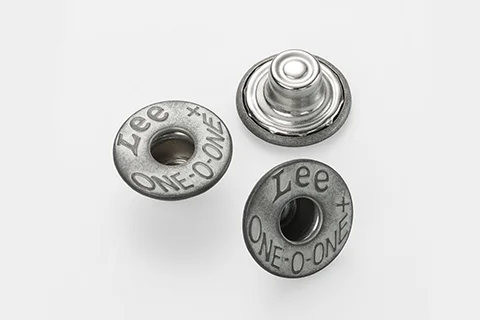
All tooling development at Songji stays inside the factory campus — from design drawing through electrode machining to die trial and first-sample sign-off, run within one system, not parcelled out to separate workshops. The single-die multi-cavity stamping process — 6 snap fastener pairs from one die stroke, multiple tack button tacks from one stroke — ensures every piece from the same die holds the logo at the same dimension and depth. Prototyping compresses to 3 to 5 working days. The full path from receiving the drawing to first sample to mass production can complete within a month.
II. How Raised, Recessed and Laser Logo Processes Survive Repeated Denim Washes
The hardest test for premium denim buttons does not happen at the factory gate. It happens in the garment wash. Enzyme wash, stone wash, sand wash, bleach wash — each washing process challenges the logo surface structure in a different way.
The biggest risk for a raised logo is abrasion. During stone washing, buttons collide repeatedly with stones. The plating and edge definition of the raised portion take the most concentrated force. LEE's custom buttons received an edge rounding treatment at the tooling stage — not a simple chamfer, but a transition that keeps the logo outline sharp while ensuring the edge does not catch fabric or feel abrasive during long-term skin contact. After 3 rounds of wash simulation, logo three-dimensional retention is a fixed item on Songji's outgoing inspection checklist.
A recessed logo with infill paint tests the adhesion and colour fastness of the filler. The colour paint needs to form a chemical bond with the metal substrate during high-temperature curing, not just a physical overlay. On GAP's multi-colour custom orders, Songji runs a separate wash colour-fastness test for every colour formula, escalating through 24, 48 and 72 hours, confirming the paint layer neither detaches nor fades in the chemical environment of water and detergent.
A laser-engraved logo is relatively stable through washing — no physical raised surface to abrade, no paint to delaminate. But the engraving contrast relies on an oxidation reaction on the copper alloy surface, which can show a visible colour shift after washing. For DIESEL's laser-engraved custom order, Songji added a post-processing step — a micro-sealing treatment applied after engraving that keeps the pattern contrast stable after washing without altering the antique finish.
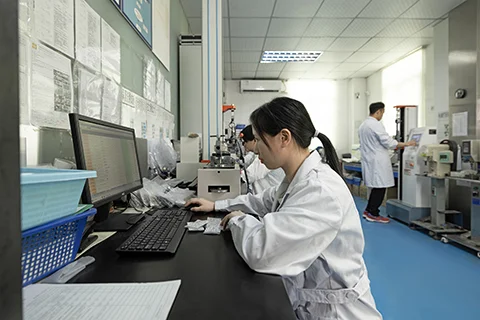
Songji runs standard metal buttons to a 72-hour neutral salt spray benchmark, 50% longer than the 48-hour industry norm. Custom high-end pieces for workwear denim and outdoor use also go through a CASS copper-accelerated acetic acid salt spray test. The more stable the plating, the better the logo holds up after washing. This item appears on the audit checklist of every premium denim brand.
III. Matching Jeans Button Plating to Brand Aesthetics
Plating on denim buttons is not a "pick a colour" decision. Antique brass and electroplated nickel deliver completely different visual feedback against fabric — one pulls toward vintage, the other toward modern minimalism.
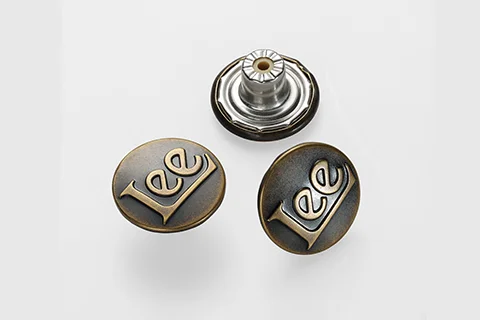
The antique brass process path runs oxidation treatment plus frosted plating — an electroplated copper base on the alloy substrate, then an oxidation bath that creates an uneven dark oxidised layer on the surface, finished with localised matte polishing to reveal the underlying copper tone. The difficulty with this process is batch consistency in the antique effect — slight variations in oxidation bath concentration, temperature or immersion time all produce colour shifts. Through its work with LEE and DIESEL, Songji moved antique-finish batch control from experience-based to data-based — each batch's oxidation bath concentration and temperature curve is logged, and outgoing colour comparison runs against a standard light box batch by batch, keeping the long-term defect rate below 0.3%.
Electroplated nickel runs the opposite route — cool silver tone, even lustre, suited to brands with a cleaner modern aesthetic. Across GAP's multiple lines, some collections specify nickel rather than antique brass. Songji presents the matching surface finishing options at the prototyping stage based on the fabric colour and design direction of each product line.
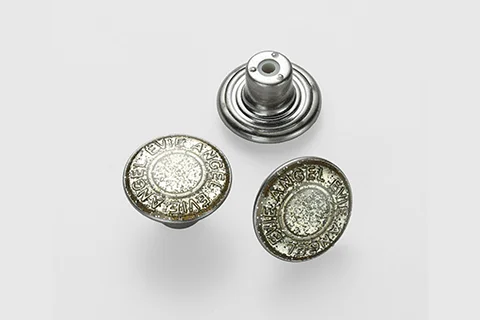
Spray coating and electrophoretic finishing cover the scenario of brand-specific colour matching. When the logo colour needs to align tightly with a brand's visual identity, traditional electroplating cannot do precise colour matching. Spray coating and electrophoretic finishing can reference a RAL or Pantone code directly for sampling. Songji currently holds over 100 national patents, launches hundreds of new designs each month, and spans more than 10,000 styles from standard plating to custom colour across the full product range.
IV. Prototyping and Reorder Consistency on Custom Logo Denim Buttons
The biggest hidden cost in custom logo buttons is not the tooling fee. It is reorder consistency. The first trial order is usually small — a few hundred to a few thousand pieces while the brand tests the market. Once the brand has accepted the quality and sold through a season, the next order may be tens or hundreds of thousands. If the original die was not preserved after the first run, or if a new die was cut for the reorder, the logo can drift.
Songji manages tooling digitally. Every custom logo die is assigned a unique die code at entry, linked to the brand name, prototyping date, material specification and first-run production data. On reorder, the original die is pulled and returned to the production line. No new die is cut. Cross-batch logo deviation is recorded in the inspection archive, with every shipment backed by its own test data and the archive retained for 5 years.
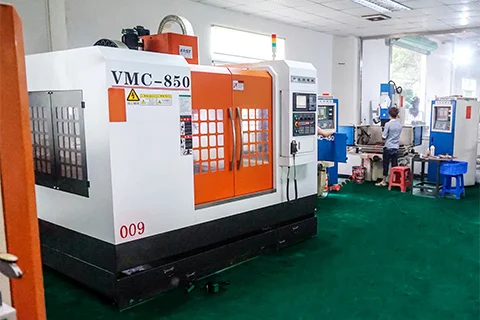
New die development follows a standard path from design drawing to production: requirements discussion, proposal confirmation, die trial, first-sample sign-off, mass production. All die machining and electroplating at Songji closes within the 12,000 m² factory campus. Among close to 700 machines, the fully automated high-speed presses and CNC machining centres handle the full workflow. Prototyping compresses to 3 to 5 working days, and the full first-sample-to-production cycle stays within one month.
V. How We Developed Custom Logo Buttons for LEE and GAP
LEE and GAP followed two completely different customisation paths, but they passed through exactly the same set of verification gates.
LEE's path is raised logo plus antique brass. The material is high-strength H65 brass — denim fabric is thick and takes heavy lateral pull during wear, so under-specced base metal hardness leads to tack loosening after extended use. The logo uses the raised process, with the height precisely controlled in the band where a fingertip registers the brand mark without affecting wearing comfort, and the edges radiused to prevent fabric snagging and skin abrasion. The surface finish follows the antique brass route — oxidation treatment followed by localised matte polishing to expose the underlying copper tone, forming a unified vintage visual language with the indigo and wash texture of the denim. Every batch passed 3 rounds of wash simulation with logo retention and plating adhesion tested before shipment.
GAP's path is zinc alloy with multiple lines and multiple platings. GAP's product range is broad, with significant differences in fabric and design style across collections, so the buttons need to switch flexibly between colours and processes. Songji presented multiple electroplating schemes at the prototyping stage — antique brass for workwear styles, nickel for clean-line collections, and spray-coated brand colours for specific colour-matching requirements on selected pieces. Choosing zinc alloy kept the material within the strength requirement while controlling the cost band, and the diversity of surface finishing covered every GAP line from essentials to statement pieces.
Both paths run through the same verification system inside Songji — defect rate below 0.3%, batch-level test data, 5-year archive traceability. LEE's and GAP's compliance teams each came to audit the factory. Over the past 10 years, Songji has passed 72 international brand audits, with quality management and document traceability as mandatory items every time. Chemical compliance — OEKO-TEX Standard 100 Class I, REACH-compliant products, self-imposed heavy metal limit of no more than 40PPM — is the first barrier any brand must clear before reaching the audit stage.
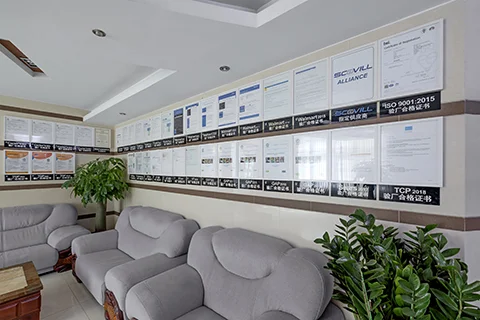
Songji Buttons was founded in 1999, has focused on metal buttons for 27 years, operates a 12,000 m² production base in Shenzhen with close to 700 machines, holds OEKO-TEX Standard 100 Class I and ISO 9001 certifications, has passed 72 international brand audits over the past 10 years, and supplies custom metal buttons to brands including LEE, GAP, DIESEL and Carter's. If you need custom logo denim buttons, we would love to hear from you. Get in touch today.