A pair of jeans carries more hardware than most buyers notice. A jeans button on the waistband, rivets on the pocket corners, eyelets for the drawcord, plus the small rivets that pin the leather patch on the back — every one of them sits on a point that is pulled, washed and rubbed daily. Order the main button and treat the rivets and eyelets as an afterthought, and the whole production comes back with a loose waistband, a torn pocket corner or a missing eyelet, a loss no price difference can recover. Songji has made metal buttons and garment hardware for 27 years, and we have watched too many denim orders fail because the hardware was not matched as a set. If you are sourcing custom jeans buttons and denim hardware for a jeans or workwear line, this guide walks you through the categories, the structures and the checks to make before you place an order.
I. What Denim Hardware Actually Includes
Denim hardware sourcing starts with knowing the full set, not a single button. The jeans button is the anchor, fixed to the waistband and the fly to hold the garment shut. The rivets are the reinforcement, pinned on the pocket corners and stressed seams that are most likely to burst. The eyelets are the openings, giving the drawcord and laces a clean hole to run through. Beyond those three sit the small rivets that pin the back leather patch and the decorative metal badges.
These three — jeans buttons, rivets and eyelets — have to arrive together, and they have to match in colour and finish. A buyer who orders the button from one factory and the rivets from another ends up with two batches that were never meant to sit on the same garment, and the mismatch only shows once the jeans are washed and the colours drift apart. A waistband button in antique brass next to a bright-silver rivet shows the moment the jeans are worn. When we take a denim order, the first thing we do is not quote a price; it is sorting out the category and quantity of every piece in the set, so the bulk run does not come back missing one part or off in colour.
II. Choosing a Jeans Button
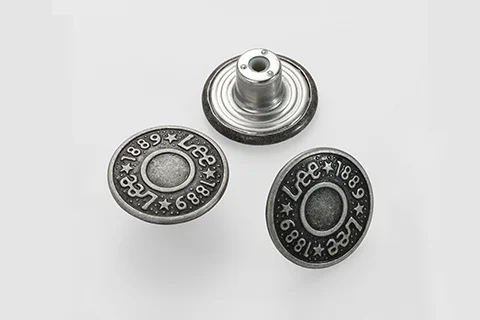
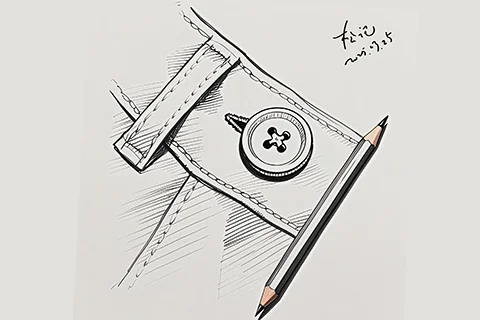
The jeans button is the core of denim hardware and the easiest one to get wrong. It is a two-part fitting: a button face on the outside, and a tack driven in from the back of the fabric, whose shank is gripped and mechanically expanded by the face, so the whole thing is permanent once fitted. That structure decides its working load — a jeans button does not take a perpendicular pull, it takes the shear force that runs along the fabric when the waistband is tightened against the body.
Jeans button sizes follow the placement: the main waistband button commonly runs 17 to 20 millimetres, and the smaller fly button 14 to 17 millimetres, with the specification scale running from 16L (about 10 millimetres) up to 32L (about 20 millimetres). The structure splits into four kinds — rubber-core, single-pin, double-pin and rotating — and the single-pin and double-pin each divide further into pierced and solid faces. Fabric thickness matters as much as size: a rubber-core or single-pin jeans button is set through 2 to 8 layers of denim, while the double-pin is meant for 2 to 6 layers on elastic knit, where it grips the fabric instead of slipping. The rubber-core suits close-fitting light fabric, while the rotating button is for designs that twist open. Pin down the waistband and fly sizes first, then match the structure to the fabric weight; get this step wrong and every mould and sample after it is wasted.
The jeans button vs snap button question comes up on nearly every denim order, and the two work differently. A snap fastener is a closure with its own stud and socket that open and close again and again, while a jeans button is a fixed part that works through a buttonhole — once the tack is locked in, it stays shut. If the design needs an opening customers fasten and unfasten every day, that calls for a snap; if it needs a waistband that stays closed, that calls for a jeans button.
III. Rivets and Eyelets in Denim Hardware
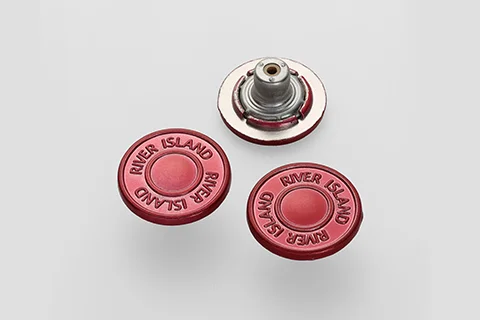
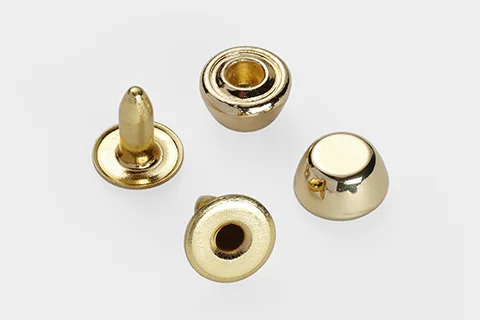
A rivet is a two-part reinforcement, a cap and a pin, pinned on the pocket corners and stressed seams most likely to give way. It does not open and close, it only holds against pulling, so when one falls off it means that stress point has already failed. Rivets come in four common kinds — domed, reverse-domed, punched washer and capped — with the domed type the most common and able to punch through 2 to 12 layers of denim.
The punched washer is a single disc with no dome that reads visually like a dome, used on leather where it must not scratch the hide. The capped type is a button face paired with a reverse dome, takes a logo, and suits leather and heavy canvas. An eyelet is a ring with a hole in the middle, giving a clean opening for drawcords, laces and hat vents, and it has to match the hole it fills — the outer diameter sits against the fabric, while the back edge is where a cheap one cuts first. The shared trap is judging these by unit price — an eyelet with a burred edge cuts the drawcord the first time it is threaded, and one badly pinned rivet leaves a pocket corner with a permanent bulge.
The strength test for rivets is a direct pull: pulling the face off the pin or tearing the fabric. What that figure should be is not universal. Some brands write a fixed number into their specification sheet; others simply inherit whatever their supplier works to. Songji's own internal line holds domed, reverse-domed and capped rivets to about 196 N (roughly 44 lb), and the punched washer to about 98 N (roughly 22 lb) because of its different structure — that is our requirement, not a market-wide value.
Before signing, ask two things: which method and which direction, since the same rivet pulled straight and pulled sideways returns two different numbers; and whether the line comes from your specification sheet or from the supplier's own control standard. Treat the second as the first and the figure will not match the next factory you quote.
IV. Denim Hardware Materials and Compliance
Denim hardware is made mainly from brass, alloy, stainless steel and iron. Brass is the classic, with a warm golden finish, strong corrosion resistance and room for a fine engraved logo. Alloy is die-cast into complex reliefs and three-dimensional logos, the mainstay of custom designs. Stainless steel resists rust for outdoor and workwear use. When choosing metal buttons for jeans, match the material to the logo too — brass takes a finer engraved line, while alloy is die-cast into deeper, more complex reliefs, so fine line work calls for brass and bold three-dimensional marks for alloy.
Iron is the cheapest and holds tension well, but it carries two hard limits. The first is nickel-free plating — iron must take a nickel base layer before plating so the finish resists rust and grips the surface, and that layer cannot be removed, so iron cannot be made nickel-free. The second is needle detection — the detector works by magnetism, so an iron button trips the alarm on a finished garment, and clothing bound for Japan and Western markets almost always has to pass needle detection. Together these two limits push iron out of mainstream denim hardware, which is why a serious factory asks your target market before recommending a material. For denim buttons and hardware, that question decides the material: brass and alloy for most denim and workwear, stainless steel for outdoor, and iron only where no needle-detection rule applies. At Songji, raw material passes a spectrometer and a heavy-metal analyser the moment it enters the plant, keeping lead content within 60 ppm, tighter than the 90 ppm total-lead limit of OEKO-TEX Class I, so a bad batch is stopped before a single button is stamped.
Compliance limits get muddled because three different layers sit on top of each other. The first is the legal floor: REACH restricts lead in trims to 500 ppm, and below that line is simply the price of entry to the EU. The second is the certification gate: OEKO-TEX Class I caps total lead at 90 ppm, the baby-grade standard that puts a supplier on many brand lists. The third is supplier control: our own line sits at 60 ppm, set by us, tighter than the certification gate but a description of our capability rather than a market requirement. Keep the three apart and a supplier's report stops collapsing into one reassuring word.
V. Custom Jeans Buttons: Four Checks Before Ordering
Custom denim hardware lives or dies on the logo file, and that is where most projects stall. What the factory needs is a vector file, not a screenshot or a low-resolution bitmap — an image that looks clean on screen blurs the moment it is stamped onto a button face. File, size and finish are the three inputs that let a press schedule the job at all; leave one out and the sample sits in a queue.
Second, ask for the sampling lead time before you commit. We turn a sample in three to five days, and that figure is worth putting to every supplier you talk to — one that cannot answer usually has no clear production schedule behind it.
Third, judge the sample on three points: whether the logo edge is crisp, whether the relief has real depth, and whether the colour matches the reference you approved. Antique brass and gunmetal are not just colours; they come from an oxidation treatment that darkens the recesses and leaves the raised logo lighter, which is what gives a relief its depth. A colour sprayed on top instead reads flat and wears off at the first wash.
Fourth, pin down the money and the ownership in the contract: whether the mould fee is a one-time development cost or charged on every order, whether a repeat order pays it again, who owns the mould at the end, and whether a run below the minimum order quantity attracts a batch fee. None of these belong in a verbal agreement. The fee itself is quoted against your design rather than pulled off a price list, because a brass part is stamped while an alloy part is die-cast, the two sit in different cost brackets, and a complex design is evaluated separately again.
VI. A Jeans Hardware Sourcing Checklist
Once the type is right, lock the quality numbers down in writing before the presses run — four items, each of them in a specification sheet or a contract rather than a verbal promise.
First, tolerance. Our presses hold ±0.05 millimetres on standard parts and ±0.025 on functional parts, and that is our capability, not an industry figure. What you need is the number your supplier will commit to in writing, because a jeans button a fraction of a millimetre off feels too tight or too loose the moment a customer fastens it. Second, pull strength: jeans buttons, rivets and eyelets are all tested by direct pull, with Songji holding a single-pin or rubber-core jeans button to about 196 N (roughly 44 lb), a double-pin to about 147 N (roughly 33 lb), rivets to about 196 N and eyelets to about 88 N (roughly 20 lb). Direct pull means pulling the part off the fabric at a right angle; the same part pulled sideways gives a different number, so fix the method first and compare figures second, or the same part will read twice as strong from one factory as from another.
Third, the finish: antique and gunmetal finishes only prove themselves under salt spray. Our tiers run 1% concentration for 24 hours on standard buttons and 5% for 50 hours on luxury garment accessories, the harsher condition giving the harder plating — those are our tiers, and the question to put to any supplier is which tier it tested to and whether it can hand over that report. Fourth, the records: Songji keeps test records for at least five years per batch, ready to pull out for a spot check, and a factory that cannot produce last year's report for last year's batch has no archive worth the name. Fifth, the lead time: with a standard finish and colour, our regular order runs about 14 days, so the whole set arrives together rather than one piece at a time.
Then look at the audit record. Songji has passed 72 international brand audits over the past 10 years .Ask to see the originals; a factory that has them will show them, and one that only says it works with big brands will change the subject.
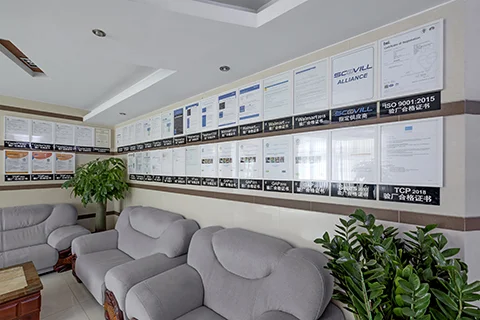
Songji is based in Guanlan, Longhua, Shenzhen, with a 12,000-square-metre factory and nearly 700 machines covering high-speed automatic presses, CNC machining centres and mirror-spark machines, a source factory focused on custom metal buttons and garment hardware for 27 years. The product line covers jeans buttons, rivets, eyelets, snap fasteners, prong snaps, shank buttons, metal badges, hooks and belt buckles, in brass, stainless steel, iron, aluminium and alloy, with barrel plating, rack plating, spray painting and vacuum plating all in house and more than 10,000 styles on record. The factory holds ISO 9001:2015, OEKO-TEX Standard 100 Class I and GRS certification, and has long supplied jeans buttons, rivets and full denim hardware sets to brands such as LEE, GAP and Carhartt. If you are building a jeans line and want a hardware set that lasts and matches, we would be glad to talk. Want to learn more? Contact us.