The gap between luxury garments and ordinary ready-to-wear is rarely in the fabric. More often it sits in the details a customer actually touches: the weight of a metal button, the action of a snap fastener, the crispness of a logo on a metal badge. For a buyer, the visible cost of custom metal trimmings is the unit price; the hidden cost is consistency, and that is where luxury truly begins. Songji has made high-end metal trimmings for 27 years and knows these differences intimately. If you are a sourcing manager choosing a metal trimmings supplier for a premium brand, this guide walks you through the standards that justify a luxury position.
I. Why Luxury Apparel Cannot Rely on Standard Metal Trimmings
Mass-produced metal trimmings are built for cost and speed. The material is usually zinc alloy die-cast, and the metal colour comes from a surface plating. That works fine in fast fashion, but on a luxury garment the shortfall shows the first time a customer touches it: a thin plating, edges that are not quite smooth, a fastening that feels cheap. Luxury apparel asks metal trimmings to make the leap from workable to scrutinised. The material must be real, the workmanship fine, and every batch identical to the last. These three points are the dividing line between an ordinary trimmings factory and a high-end one.
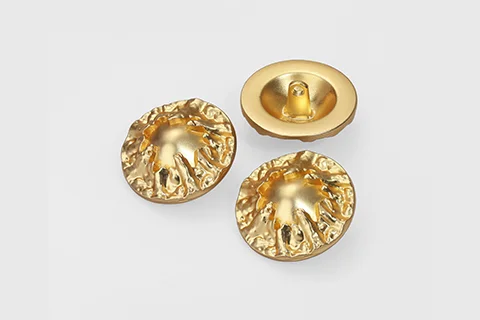
II. Solid Copper and Stainless Steel Metal Buttons vs Cheap Zinc Alloy
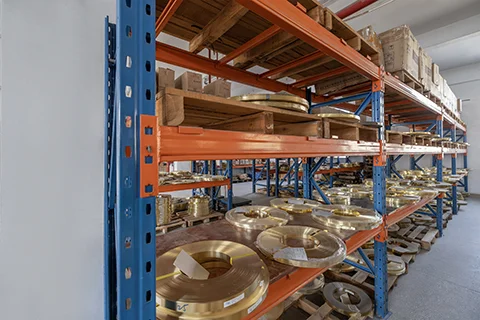
For a metal button, the material is the first test of quality. Solid copper is ductile and warm to the touch, the benchmark choice for premium garments. Stainless steel resists corrosion and offers high structural strength, so it suits categories that demand durability. Zinc alloy is cheap to die-cast and can be plated to look like copper or silver; visually it can pass, but in weight, feel and durability it falls clearly short of the real thing. Songji uses 300 tonnes of copper and 60 tonnes of alloy every month, and every batch of raw material passes a spectrometer, a heavy metal tester and a Rockwell hardness tester before it enters production. When you assess a factory, one useful question is whether its copper content and plating thickness are backed by test data.
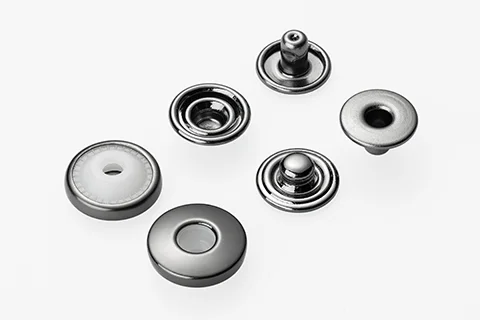
III. Surface Finish That Sets Luxury Snap Fasteners Apart
Snap fasteners are the most common metal trimming on coats, jackets and leatherwear, and the part a customer opens and closes most often, so their quality is the easiest to feel. The same snap fastener can look completely different depending on the finish: polished, matte, antiqued, or a genuine gold PVD coating. Premium brands are not asking for a thin layer of gold; they want an even coating, smooth edges, a stable opening force and no colour loss after repeated use. Songji's snap fasteners hold a tensile strength above 35 kg, and its salt spray testing runs at two levels: ordinary buttons are tested at 1% concentration for 24 hours, while trimmings for luxury garments go to 5% concentration for 50 hours, a stricter requirement. Corrosion and wear resistance are both backed by data. And those test figures are what keep the quality stable over time.
IV. Custom Logo Jeans Buttons and Bespoke Metal Badges
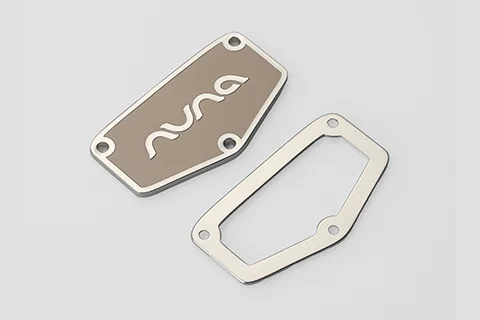
What luxury brands care about most is how precisely their identity appears on a trimming. The logo on a jeans button or the lettering on a metal badge, whether the lines are sharp, the depth consistent and the edges clean, speaks directly for the brand. An ordinary factory cuts its moulds roughly and the logo edges come out soft; a high-end factory runs CNC machining centres and mirror-spark machines on its tooling so every button carries a crisp logo. Songji holds over 100 national patents and has developed more than 10,000 product styles, adding around 100 new styles every month, a large share of them bespoke logo jeans buttons and metal badges for brands. Burberry's bag hardware and PORTS' high-end women's wear metal buttons are examples of this craft. How strong a factory's custom capability is decides whether it can turn a design concept into a physical piece that holds up under magnification.
V. Precision Tolerance in Shank Buttons and Hooks
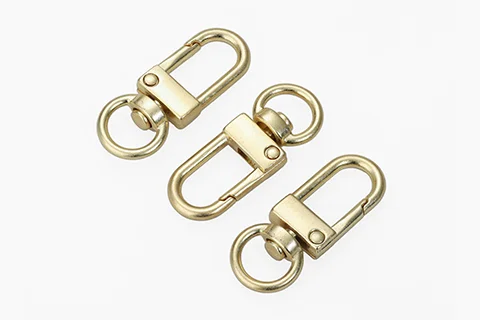
The trimmings on luxury apparel often hide in the details. On suits and coats, the tolerance of a shank button directly decides how it feels as it slips through the buttonhole; on bags and pushchairs, a hook with poor precision can work loose or fall off. Songji holds general dimensional tolerance to ±0.05 mm and functional parts to ±0.025 mm, a precision delivered alongside the one-shot, multi-piece stamping process run on nearly 700 machines, so fine detail and efficiency are both preserved. When you evaluate a factory, tolerance is a hard number, and being able to hold it consistently matters far more than being able to hit it occasionally.
VI. Batch Consistency in Metal Buttons and the Hidden Cost of Defects
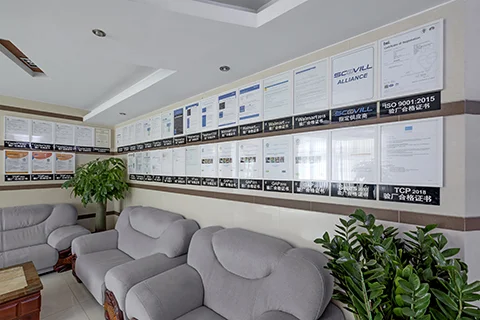
The pain point in luxury is batch consistency. Making the first sample batch look good is not hard; keeping batch number 100 identical to batch number one is. The slightest drift in colour, sheen or dimension is enough for a customer to sense the batch is off. Songji keeps its full-batch defect rate below 0.3%, with more than 150 standardised quality control procedures covering everything from raw material to finished product, and test records kept for at least five years. Over the past 10 years Songji has passed 72 factory audits from brands including Walmart, GAP, VF, Carhartt and Carter's. The standard those brands demand for consistency is itself an industry benchmark. Choosing a factory that has cleared 72 audits carries far less risk than choosing one that simply promises there will be no problems.
VII. OEKO-TEX and Heavy Metal Control for Luxury Metal Trimmings
Luxury brands hold trimmings to far stricter compliance than the mass market. Garment hardware sits against the skin for long periods, and a single failure on heavy metals, nickel release or azo dyes can condemn an entire batch. Songji's metal trimmings pass OEKO-TEX Standard 100 Class I, a safety level written for baby products, and control lead and other heavy metals to within 40 PPM, stricter than the general industry norm. The factory also holds ISO 9001:2015 quality management certification and GRS Global Recycled Standard certification. When you screen suppliers, compliance certificates are not a bonus but a ticket to enter: a factory without them cannot withstand a luxury brand's audit, no matter how good its samples look.

VIII. A Practical Checklist for Sourcing Luxury Metal Trimmings
Pull the earlier criteria into a checklist you can work through when assessing a factory: is the material genuine and backed by test data; will the surface finish and plating resist wear and corrosion; can the logo be rendered with sharp lines and fine tooling; can tolerance be held at ±0.025 mm consistently; is batch consistency supported by defect data and audit records; and are the compliance certificates complete. A factory that ticks every box is one that can run alongside a luxury brand for the long term. Songji has been making metal buttons and garment hardware since 1999, has served more than 100 brands, and turns a sample around in three to five days from design to production, willing to work through every detail with a brand.
Songji is based in Guanlan, Longhua, Shenzhen, with a 12,000-square-metre factory and nearly 700 machines covering high-speed automatic presses, CNC machining centres and mirror-spark machines. It is a source factory that has focused on custom metal buttons and garment hardware for 27 years. The product line covers metal buttons, snap fasteners, jeans buttons, tack buttons, shank buttons, rivets, metal badges, hooks and belt buckles, in copper, stainless steel, iron, aluminium and alloy. The factory holds ISO 9001:2015, OEKO-TEX Standard 100 Class I and GRS certification, has passed 72 audits from international brands over the past 10 years, and keeps its full-batch defect rate below 0.3%.
If you are looking for a dependable metal trimmings supplier for a luxury brand and want every button and snap fastener to stand up to a customer's scrutiny, we would be glad to talk. Want to learn more? Contact us.